

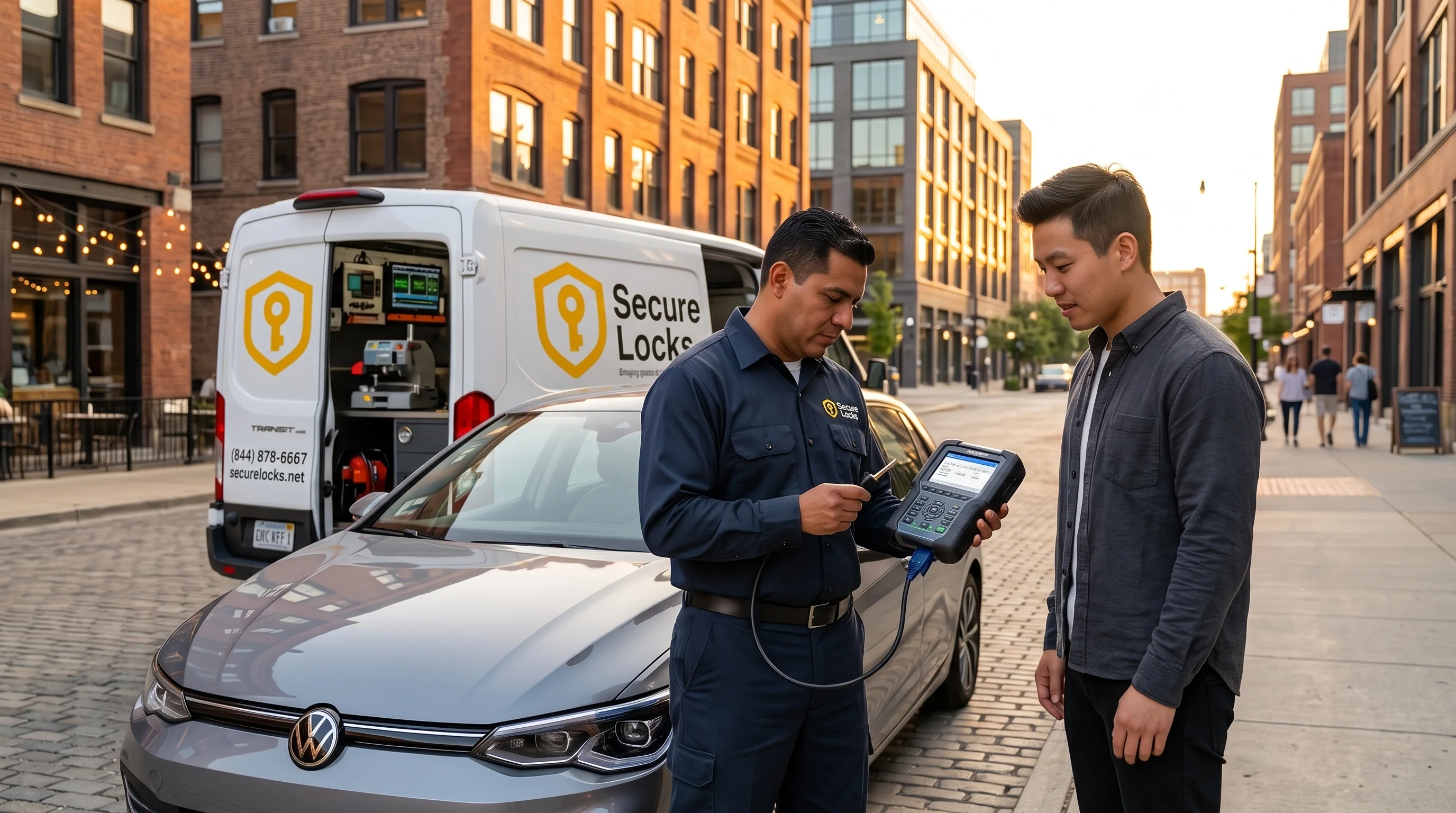
A newly cut car key can look perfect and still fail to start the vehicle. That surprises many drivers because the blade fits the lock, turns correctly, and may even unlock the door. The missing piece is often electronic rather than mechanical. Many modern vehicles require the key to communicate with an immobilizer, transponder system, or proximity module before the engine will start.
That is where an automotive key programmer becomes important. For drivers in Chicago, understanding the difference between cutting a key and programming one can prevent confusion when a duplicate appears physically correct but does not function like the original. Modern automotive keys are no longer just pieces of shaped metal; they are security devices designed to exchange coded information with the vehicle.
Why an Automotive Key Programmer Is Needed for Modern Car Keys
Older vehicle keys were primarily mechanical. If the blade matched the lock and ignition cylinder, the key could usually operate the vehicle. Modern cars introduced electronic theft-deterrent systems that changed that process significantly. Many keys now contain transponder chips or communicate wirelessly with the vehicle, and the car must recognize the electronic identity of the key before allowing the engine to start.
An automotive key programmer is used to establish or configure that electronic relationship when the vehicle and key require it. Depending on the system, this may involve adding a transponder key, pairing a remote, registering a smart key, or communicating with the vehicle’s immobilizer. Without that step, a newly cut key may perform only part of its intended job.
An Automotive Key Programmer Does More Than Duplicate a Blade
Key cutting and key programming solve two different problems. Cutting creates the physical pattern that interacts with a lock or ignition cylinder, while programming addresses electronic authorization. A vehicle that uses both systems requires both parts to work correctly.
This distinction matters because a driver may successfully unlock the door with a freshly cut key and assume something is wrong with the ignition when the engine does not start. In reality, the blade may be correct while the electronic portion has not yet been accepted by the vehicle.
For Chicago drivers using newer cars, SUVs, vans, and trucks, that situation is increasingly common because transponder and smart-key technology has been standard on many vehicles for years.
Why an Automotive Key Programmer Matters With Transponder Keys
A transponder key contains a small electronic chip that communicates with the vehicle’s immobilizer system. When the key is used, the vehicle looks for an authorized electronic response. If that response is missing or incorrect, the immobilizer can prevent the engine from starting even when the physical blade turns normally.
An automotive key programmer can be necessary to register the transponder so the vehicle recognizes it as authorized. This is why copying only the blade of a transponder key does not necessarily create a functional spare.
The difference can be easy to overlook because the chip is often hidden inside the plastic head or fob housing. From the outside, the key may appear no more complicated than an older mechanical key.
When a Simple Car Key Cut Is Not Enough
A simple cut may be sufficient for certain older vehicles or for some mechanical emergency blades, but many modern applications require additional steps. The key type, vehicle year, manufacturer, immobilizer system, and available programming procedure can all influence what is needed.
For that reason, identifying the key system should happen before assuming that duplication is purely a cutting job. A physical copy that cannot communicate electronically may provide door access while leaving the driver unable to start the vehicle.
Push-to-Start Vehicles Often Require an Automotive Key Programmer
Push-button-start vehicles rely heavily on electronic communication. Instead of inserting a blade into the ignition, the vehicle detects an authorized smart key or proximity fob nearby. If the system recognizes the key, the driver can start the engine by pressing the button.
A replacement fob therefore needs more than the correct exterior shape. The electronic credentials must be compatible with the vehicle and, in many cases, properly registered. An automotive key programmer may be involved in that process so the vehicle can distinguish the replacement from an unauthorized device.
This is especially relevant in Chicago, where many drivers depend on push-to-start vehicles for daily commuting and may not encounter the underlying technology until a key is lost, damaged, or stops working.
Remote Functions May Need Separate Programming
Locking and unlocking the doors remotely can involve another layer of communication. On some vehicles, transponder authorization and remote-control functions are handled together, while on others they may require different procedures.
That means a replacement key could start the engine but still have nonfunctional remote buttons, or it could unlock the doors remotely while failing to authorize the engine. Proper testing is important because a replacement should be evaluated according to all the functions it is expected to perform.
How an Automotive Key Programmer Works With Car Key Replacement
Modern car key replacement can involve several distinct stages. First, the correct key or fob must be identified for the vehicle. If a physical blade is used, it must be cut correctly. Then the electronic portion may need to be programmed or registered, followed by testing to confirm that the vehicle recognizes the new key.
An automotive key programmer is one of the tools that can help complete the electronic portion of that process. Its role is especially important when the replacement must interact with an immobilizer, transponder system, remote-entry module, or smart-key system.
Car Key Replacement Is Both Mechanical and Electronic
Thinking of car key replacement as a single step can be misleading. With many modern vehicles, it is more accurate to think of it as a combination of mechanical compatibility and electronic authorization.
The blade must physically match where required, but the vehicle must also accept the electronic identity of the key. If either side is missing, the replacement may be incomplete.
For Chicago drivers, this distinction becomes particularly important after losing the only working key. When no functioning original remains, identifying the correct replacement and programming path becomes more important because there is no spare available for comparison.
Signs an Automotive Key Programmer May Be Required
Several common situations suggest that programming may be part of the solution. A newly cut key may unlock the vehicle but fail to start it. A replacement fob may have the correct buttons but produce a “Key Not Detected” message. A transponder key may turn the ignition while the immobilizer indicator remains active.
These symptoms do not prove that programming is the only issue, because vehicle-side faults can produce similar behavior. However, they do indicate that the problem may extend beyond the physical cut of the key.
A Key That Turns but Does Not Start the Engine
This is one of the clearest examples. If the blade enters and turns normally but the engine remains disabled, electronic authorization should be considered. Depending on the vehicle, the immobilizer may not recognize the transponder or the key may not have been properly registered.
Continuing to recut the same mechanical pattern will not resolve an electronic recognition problem. The mechanical side has already demonstrated that it fits.
A Replacement Fob That Shows “Key Not Detected”
Smart-key systems rely on wireless recognition. If a replacement fob consistently triggers detection warnings, the issue may involve compatibility, programming, battery condition, or the vehicle’s receiver system.
An automotive key programmer may be needed when the fob itself is correct but has not yet been registered to the vehicle. Diagnosis still matters, because programming should address a verified compatibility issue rather than being treated as a universal fix.
A Spare Key That Unlocks but Cannot Start the Car
Sometimes drivers discover an old spare that works in the door but not in the ignition system. This can happen when the blade was copied correctly but the electronic component was never programmed, or when the transponder is damaged or missing.
That situation often reveals how much automotive key technology has changed. A key can be mechanically correct and electronically useless at the same time.
Why Chicago Drivers Should Understand Automotive Key Programming
Chicago drivers regularly depend on vehicles in conditions where a nonfunctional key can quickly become disruptive. Street parking, garages, airport trips, commuting, winter weather, and dense urban traffic leave little room for trial and error when a key stops working.
Understanding that a modern key may require both cutting and programming helps drivers make better decisions before a problem becomes urgent. It also reduces the chance of assuming that a visually identical key will automatically work.
Chicago Weather Can Expose Existing Key Problems
Cold weather can make weak key-fob batteries more noticeable, while moisture can affect electronics that are already compromised. A Chicago winter does not create every key problem, but it can reveal marginal components that were already close to failure.
If a key begins producing inconsistent detection messages, reduced remote range, or intermittent starting problems, replacing the battery may be the first step. If those symptoms continue, the issue may involve programming, internal electronics, or the vehicle itself.
Chicago Parking Situations Make Reliable Keys More Important
A key problem at home is inconvenient. The same problem in a downtown garage, airport parking area, unfamiliar neighborhood, or curbside space can be much more disruptive.
That is one reason having a correctly programmed spare is valuable. A backup key should not merely fit the vehicle; it should be confirmed to perform the functions required to unlock and start it.
Automotive Key Programmer vs. Key Cutting: The Key Difference
The simplest way to understand the distinction is that key cutting addresses shape while key programming addresses identity. The blade tells the mechanical lock, “this shape fits.” The electronic component tells the vehicle’s security system, “this key is authorized.”
Modern vehicles may require both messages before they operate normally.
An Automotive Key Programmer Handles Electronic Authorization
Depending on the vehicle, an automotive key programmer may communicate through the diagnostic system, interact with immobilizer data, register a transponder, or pair a smart key. The exact process varies considerably among manufacturers and model years.
That variation is why one programming procedure should not be assumed to work for every vehicle. Automotive security systems are deliberately designed differently, and some require specific tools, credentials, procedures, or security access.
Programming Requirements Can Differ by Vehicle
Two vehicles from the same manufacturer may use different key systems because of changes in model year, trim, ignition type, or security architecture. Even vehicles that use visually similar fobs may require different programming procedures.
Correct identification matters before any programming begins. The vehicle identification details, key type, and existing key situation help determine the appropriate process.
The Automotive Key Programmer Is Only One Part of the Process
Programming technology is important, but it does not replace diagnosis. A vehicle that refuses to recognize a key could have a damaged fob, weak battery, incompatible replacement, immobilizer issue, antenna fault, or another electrical problem.
Likewise, car key replacement may require cutting, programming, testing, and verification rather than relying on a single tool. The objective is not simply to make the programmer communicate with the vehicle; it is to produce a key that works reliably for its intended functions.
What Should Be Tested After Using an Automotive Key Programmer
A programmed key should be tested thoroughly before it is considered complete. If the key has a physical blade, it should operate the intended mechanical locks smoothly. Remote buttons should respond correctly, and the vehicle should recognize the transponder or smart key consistently.
Push-to-start vehicles should start without repeated detection warnings, while traditional ignition systems should recognize the key without immobilizer-related failures. Testing should also include any intended trunk-release or remote-entry functions.
This matters in Chicago because a key that works once inside a controlled setting is not necessarily a dependable backup. Consistency is the real objective.
When Automotive Key Programming Becomes Especially Important
Programming becomes particularly important when replacing a lost key, adding a spare, replacing a damaged fob, or dealing with a key that no longer communicates reliably with the vehicle. It may also become necessary when a replacement key has the correct blade but cannot start the engine.
The earlier these situations are addressed, the more options usually remain. Drivers with one fully functioning key can compare behavior and verify the replacement before the original is lost or damaged.
A properly handled car key replacement should account for both the physical and electronic requirements of the vehicle. That is why an automotive key programmer matters: modern car keys are security credentials as much as they are mechanical tools.
For Chicago drivers, recognizing that distinction before a key problem becomes an emergency can save considerable confusion. A simple cut may reproduce the shape, but when a vehicle expects electronic authorization too, the replacement is not truly complete until the car recognizes the key and performs consistently.