

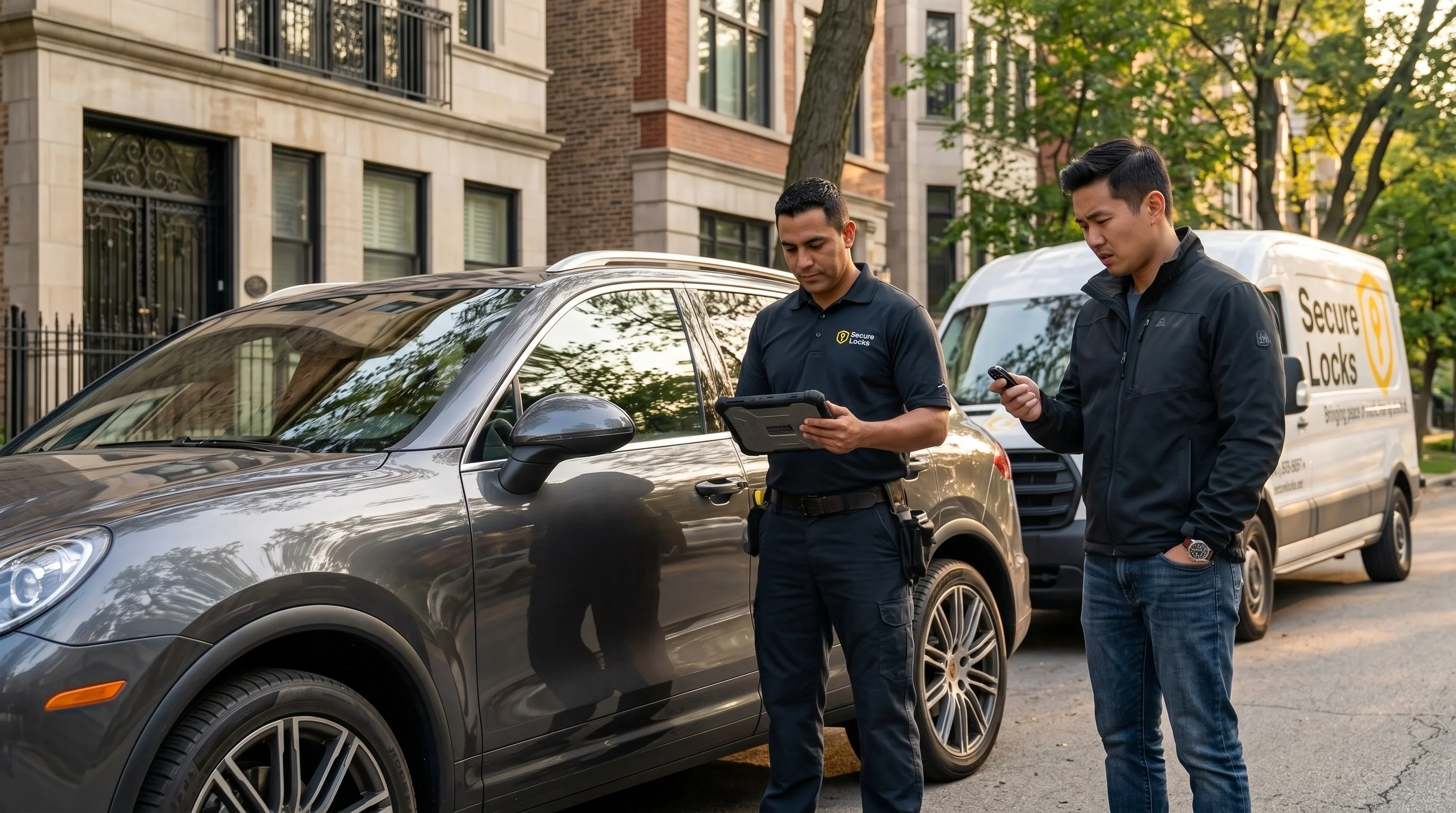
A Porsche Cayenne is built to handle Chicago winters, tight downtown garages and long highway drives, but its access system can still stop cooperating. The doors will not unlock when the handle is touched, the start button produces a message that the key is not recognized or the remote works only from a few feet away. Because the Cayenne relies on several components working together to recognize its key, the cause is not always the key itself. Before arranging car key replacement, it helps to understand how the access system works and which parts most commonly cause recognition problems.
The Cayenne has been sold across several generations since its introduction, and the access system has evolved along the way. Many models use Porsche Entry and Drive, a keyless system that lets the driver unlock the doors and start the engine without taking the key out of a pocket. Others use a key that is placed in an ignition-style receptacle. In both cases, recognition depends on a chain that runs from the key's battery and transponder through the car's antennas and control units.
How the Cayenne Access System Recognizes the Key
When the driver touches a door handle or presses the start button on a keyless Cayenne, the car sends out a low frequency signal through antennas placed in the doors, the cabin and the rear of the vehicle. The key receives that signal and replies with an encrypted response. The car checks the response against its list of authorized keys and, if everything matches, unlocks the doors or allows the engine to start.
On models without keyless start, the key's transponder answers the immobilizer when the key is placed in the ignition receptacle. The remote buttons work separately, sending lock and unlock commands by radio. Either way, the car must receive a clear, correct answer from the key before it grants access.
Why Recognition Failures Seem Inconsistent
Recognition problems often come and go. The car may find the key one morning and not the next, or recognize it in the cupholder but not in a coat pocket. That pattern usually means the signal is close to the edge of what the car can detect. A weak battery, a loose contact, interference nearby or a failing antenna can each reduce the strength of the exchange enough to make recognition unreliable.
The Key Battery and Contacts
The most common cause of a recognition problem is the key's battery. As the battery ages, the key's reply becomes weaker, and keyless systems are sensitive to that change. The remote buttons may keep working at close range long after keyless entry and start have become unreliable, which surprises many owners.
Replacing the battery with the exact type listed in the owner's manual is the first step. The battery should be installed with the correct side facing up, handled by its edges and seated firmly against the contacts. If the contacts are bent or corroded, a fresh battery may still produce weak or intermittent results. Cold weather in Chicago makes battery problems more noticeable, since low temperatures reduce output further.
Choosing and Installing the Right Battery
Not every coin cell that fits the housing is the right one. Batteries with a slightly different thickness can sit loosely and lose contact when the key is jostled, and batteries from unreliable sources may deliver less voltage than the key expects. Using the exact type named in the owner's manual, bought from a source with steady turnover, avoids both problems. When the housing is opened, it is also a good moment to look for green or white residue on the contacts and for any sign that moisture has reached the circuit board. A clean, dry interior with a fresh, correctly seated battery is the baseline before any other cause is considered. Many owners replace the battery every fall, before the first cold snap, so that a tired cell does not fail on a frozen morning when the car is parked outside.
The Backup Recognition Method
Porsche provides a backup way to start the Cayenne when the key's battery is too weak for normal recognition. The owner's manual shows the location and procedure, which usually involves placing the key at a specific spot where the car can read it at close range. If the car starts using this method, the key's transponder still works, and the problem is the key's battery or transmission rather than its authorization.
Antennas, Handles and Control Units
If a fresh battery and the backup method do not solve the problem, attention shifts to the car. Door handle antennas and touch sensors can fail, especially on vehicles that see heavy use, road salt and moisture. When one door handle responds and another does not, a component in the unresponsive door is the likely cause.
Interior antennas can also develop faults, which may produce a key not recognized message at start-up even when the doors unlock normally. The control units that manage the access system depend on stable voltage, and a weak vehicle battery can cause unpredictable behavior. Cayenne owners who see several electrical warnings at once should have the car's battery and charging system checked before focusing on the key.
Interference and Environment
Radio interference can disrupt the exchange between the Cayenne and its key. Busy garages, downtown Chicago streets and areas with heavy wireless activity can make recognition less reliable in certain spots. Inside the car, phone chargers, dash cameras and other plug-in electronics can add noise. Moving the car, unplugging accessories and keeping the key away from phones and metal objects are simple ways to rule interference out.
Testing With the Spare Key
The spare key provides the clearest comparison. If the spare is recognized normally, the main key is almost certainly at fault. If the spare shows the same symptoms, the car is more likely the source. This test takes a minute and prevents replacing a key that was never the problem.
Keeping a Simple Log
When recognition problems come and go, a short log of where and when they happen can reveal a pattern. Failures that occur only in one garage point to the environment. Failures that occur only on cold mornings point to the battery. Failures that occur everywhere with both keys point to the car. This information also helps a technician diagnose the problem faster.
When the Key Itself Has Failed
If the battery is fresh, the contacts are clean, the environment is quiet and the spare key works normally, the main key has likely failed internally. Water exposure, impact damage and gradual wear on the circuit board are the usual causes. In some cases, a fob can be repaired or moved into a new housing. In others, the practical solution is a new key prepared and programmed for the vehicle.
Car Key Replacement for a Cayenne
Replacing a Cayenne key involves more than ordering a matching shell. The new key must carry the security data the car expects, be programmed so the access system and immobilizer accept it and have its emergency blade cut to match the car's locks. The procedure depends on the generation and model year. At a dealership, a lost Cayenne key often means an ordered key, a service appointment and a flatbed tow if the car cannot be started. A mobile locksmith avoids that wait and that tow. An automotive locksmith equipped for Porsche handles this work on site, and newer Cayenne generations are handled with the same specialized equipment, sometimes with a few additional steps.
Documents and Testing
Proof of ownership is required before any key is made, typically a photo ID and the title or current registration. Once the key is programmed, every function should be tested, including remote lock and unlock, liftgate release, keyless entry at each door, keyless start and the emergency blade. If the original key was lost or stolen, it should be removed from the car's system so it can no longer be used.
When the Cayenne Cannot Be Moved
A recognition failure is most stressful when the Cayenne is parked somewhere it cannot stay. On a Chicago side street with street cleaning scheduled, in a garage that closes overnight or in a workplace lot, the location shapes the next step. If the backup recognition method works, the car can usually be driven home and the key sorted out later. If it does not, and the spare key is not nearby, a mobile technician equipped for Porsche vehicles can often diagnose the problem where the car sits and, for supported models, prepare and program a new key on site. Towing a Cayenne is possible, but its weight and all-wheel drive usually call for a flatbed, which adds time and coordination. Knowing these options in advance makes it easier to choose the quickest route when the message appears unexpectedly.
Planning Ahead for Cayenne Car Key Replacement
Cayenne owners can avoid many recognition emergencies with a few habits. Replace the key battery every year or two, ideally before winter. Store the spare key where it can be reached quickly and check it every few months. Learn the backup recognition method before it is needed. Keep the key in an inside pocket during cold weather and away from phones and metal objects.
For Cayenne drivers in Chicago, where cold temperatures, dense garages and heavy daily use all affect the access system, most recognition problems trace back to the key battery, the environment or a specific component in the car. When the evidence points to a damaged or missing key, a properly programmed new key restores every function, and that is when professional car key replacement becomes the reliable next step.