

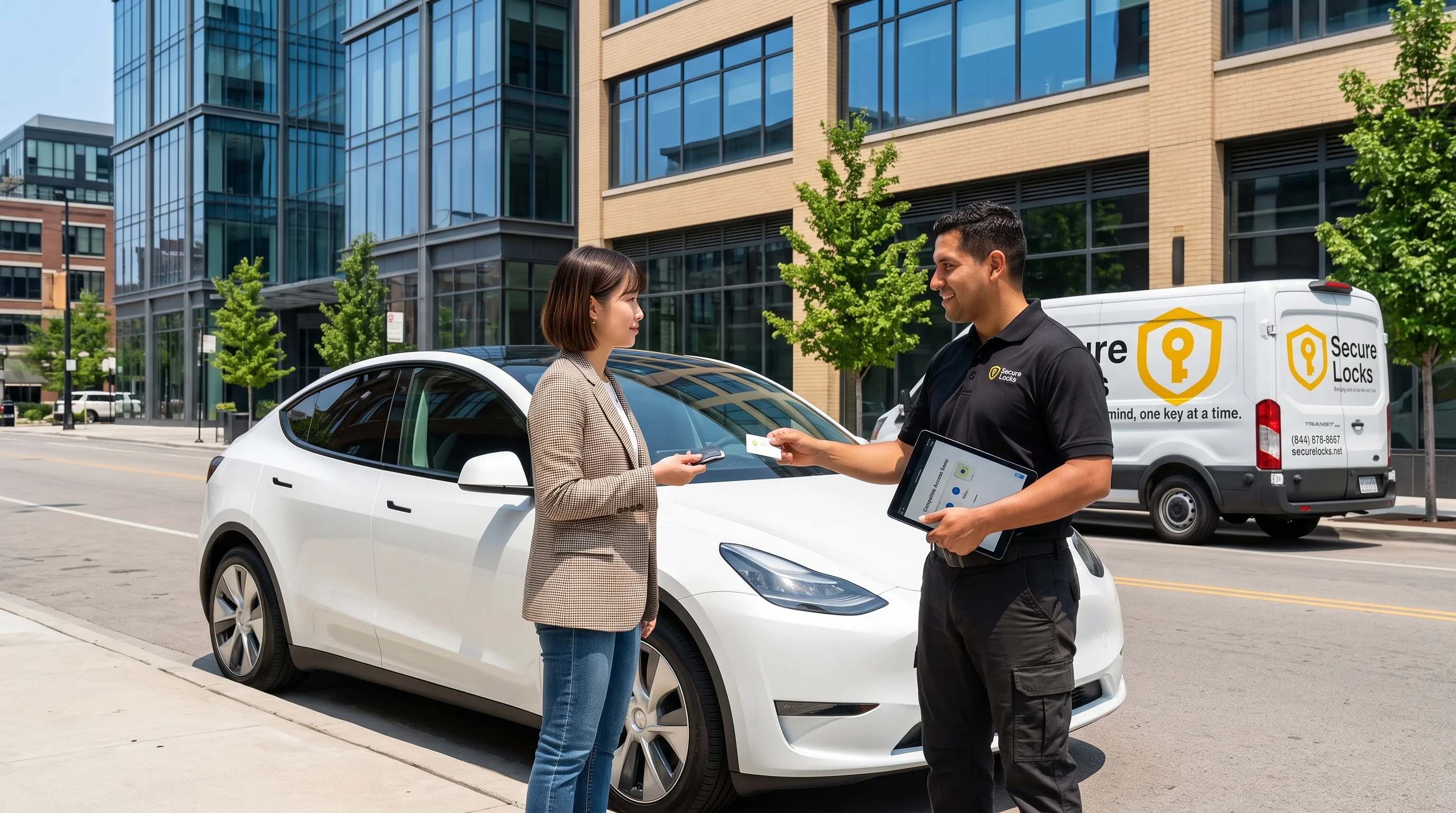
Tesla changed the way many drivers think about car keys. For a lot of owners, the phone is the key, and the car unlocks as they walk up and locks as they walk away. The thin key card that came with the car often ends up in a wallet or a drawer and gets forgotten until the day it is needed. That day usually arrives when a phone battery dies, the app will not connect, or a family member needs to drive the car. For Tesla owners in Chicago, adding a second key card before that moment is one of the simplest ways to avoid being locked out, and it works differently from traditional car key replacement in some important ways.
Understanding how Tesla key cards work, how they are added and what happens when all keys are lost helps owners decide when a spare card is enough and when a situation calls for a different kind of help.
How Tesla Key Cards Work
A Tesla key card is a credential that the car reads at close range through a card reader built into the vehicle. It does not have a battery, so it keeps working even when a phone is dead or a fob battery is exhausted. To use it, the driver taps the card on the reader to unlock the car, and on many models, places it in a specific spot inside the cabin to allow driving. The exact location of the reader varies by model and year, and the owner's manual shows where it sits on each vehicle.
Tesla vehicles can recognize several kinds of keys: a phone key through the app, key cards, and on some models an optional key fob. Each one is authorized separately, and each shows up in the car's list of keys. That list is important, because it controls which credentials can open and drive the car, and it can be managed directly from the touchscreen.
Why the Key Card Matters Even With a Phone Key
The phone key depends on the phone having power, a working Bluetooth connection and the app running correctly. Cold weather affects all three. On a frigid Chicago morning, a phone battery can drain far faster than expected, and a phone that shuts down in a parking lot leaves the driver outside the car. A key card in a wallet solves that problem instantly, which is why it makes sense to keep one with the driver at all times, not in a drawer at home.
Adding a Spare Card Versus Traditional Car Key Replacement
On most vehicles, car key replacement means cutting a blade, programming a transponder and pairing a remote. Tesla works differently. Adding a new key card is done through the vehicle's own lock settings on the touchscreen, and the process requires an already authorized key to approve the new one. In practice, the owner selects the option to add a key, taps the new card on the card reader, and then confirms the addition by presenting a key card that is already paired to the car.
That authorization step is the reason adding a spare is easy when a working key exists and much harder when none do. The car relies on an existing authorized credential to confirm that the person adding a new card has legitimate access. Without one, the car cannot approve the new card on its own.
Car Key Replacement Habits That Do Not Apply to Tesla
Drivers who have owned conventional vehicles often carry assumptions that do not fit a Tesla. There is no mechanical blade to cut, so there is nothing to decode from a door lock. A key card has no battery, so it will not fade over time the way a fob does. A card also cannot be duplicated by simply copying another card, since each credential is authorized individually through the car. On the other hand, the Tesla approach gives owners something most conventional systems do not: direct control over the list of authorized keys from the driver's seat. Removing a lost card takes a few taps rather than an appointment, and adding a new one takes minutes as long as an authorized key is present. Knowing these differences helps owners avoid chasing solutions that were designed for other cars and focus on the step that actually matters, which is keeping at least one authorized credential available at all times.
Where Spare Key Cards Come From
Spare key cards should come from a reliable source that sells cards compatible with the specific model. Some owners buy cards directly through the manufacturer's channels, while others choose compatible aftermarket cards or wearable formats. Whatever the source, the card still has to be added through the car's menus with an authorized key present, and it should be tested for unlocking and driving before being put into use.
Naming and Managing Keys on the Touchscreen
Once a card has been added, it appears in the car's list of keys. Giving each key a clear name, such as the name of the family member who carries it, makes it much easier to manage later. If a card is ever lost, the owner can remove that specific card from the list without affecting the others. This is one of the real advantages of the Tesla approach, since disabling a lost credential is quick and does not require new hardware.
Testing the New Card Before Relying on It
After the card is added, it should be tested in the real conditions it will face. That means locking and unlocking at the card reader, placing it in the correct spot to allow driving and confirming the car can be shifted into gear. Testing with the phone key turned off, or the phone left elsewhere, confirms that the card works independently.
What Happens When Every Key Is Lost
The situation becomes more complicated when there is no authorized key left at all. If the phone key is not available, no key card is paired and no fob is present, the owner cannot add a new card through the touchscreen, because there is nothing to authorize the addition. In that case, the path usually runs through the manufacturer's service channels, which have the ability to restore access after verifying ownership.
This is exactly why a spare key card is so valuable. As long as at least one authorized credential remains, the owner stays in control of the key list and can add or remove keys at will. Once the last one is gone, recovering access becomes a service process with its own timeline.
When the Phone Key Stops Working
A phone key that suddenly stops working does not always mean the key is gone. The phone may need Bluetooth turned back on, the app may need to be reopened, or the phone may need to be restarted. After a new phone is set up, the phone key usually has to be set up again through the app. A key card solves all of these situations in the moment, since it lets the driver into the car and allows the phone key to be sorted out later.
Practical Situations for Chicago Tesla Owners
Several everyday situations make a second card worth having. Valet parking at downtown Chicago restaurants and hotels often works best with a key card, since handing over a phone is not realistic. Households with more than one driver benefit from giving each driver a card, so no one has to share a phone to use the car. Owners who park in shared garages or use car washes also find it easier to hand over a card than to set up temporary access.
Winter creates its own reasons. Cold temperatures can make phone batteries unpredictable, and a driver who has been outside for a long time may find the phone has shut off. A key card tucked into a wallet provides a dependable backup without any battery at all.
Keeping Track of Every Card
It is easy to lose track of how many cards have been added over the years. Reviewing the key list on the touchscreen once in a while helps confirm that every listed key is still in someone's possession. Any card that cannot be accounted for should be removed, especially after a move, a change in household drivers or the sale of a second vehicle.
Choosing the Right Help for Key Problems
For traditional vehicles, a lost key is usually solved by programming a new one on site. For Tesla vehicles, adding a spare card is often something the owner can do directly, provided an authorized key is available. When every key is gone, or when a card reader or other vehicle component appears to be failing, the right next step depends on the specific situation, and professional help should be matched to the vehicle.
For drivers in Chicago who own both a Tesla and a more traditional vehicle, the difference is worth remembering. A Tesla spare is best added while a working credential exists, while the other car in the driveway may still need conventional car key replacement when its keys are lost or damaged.