

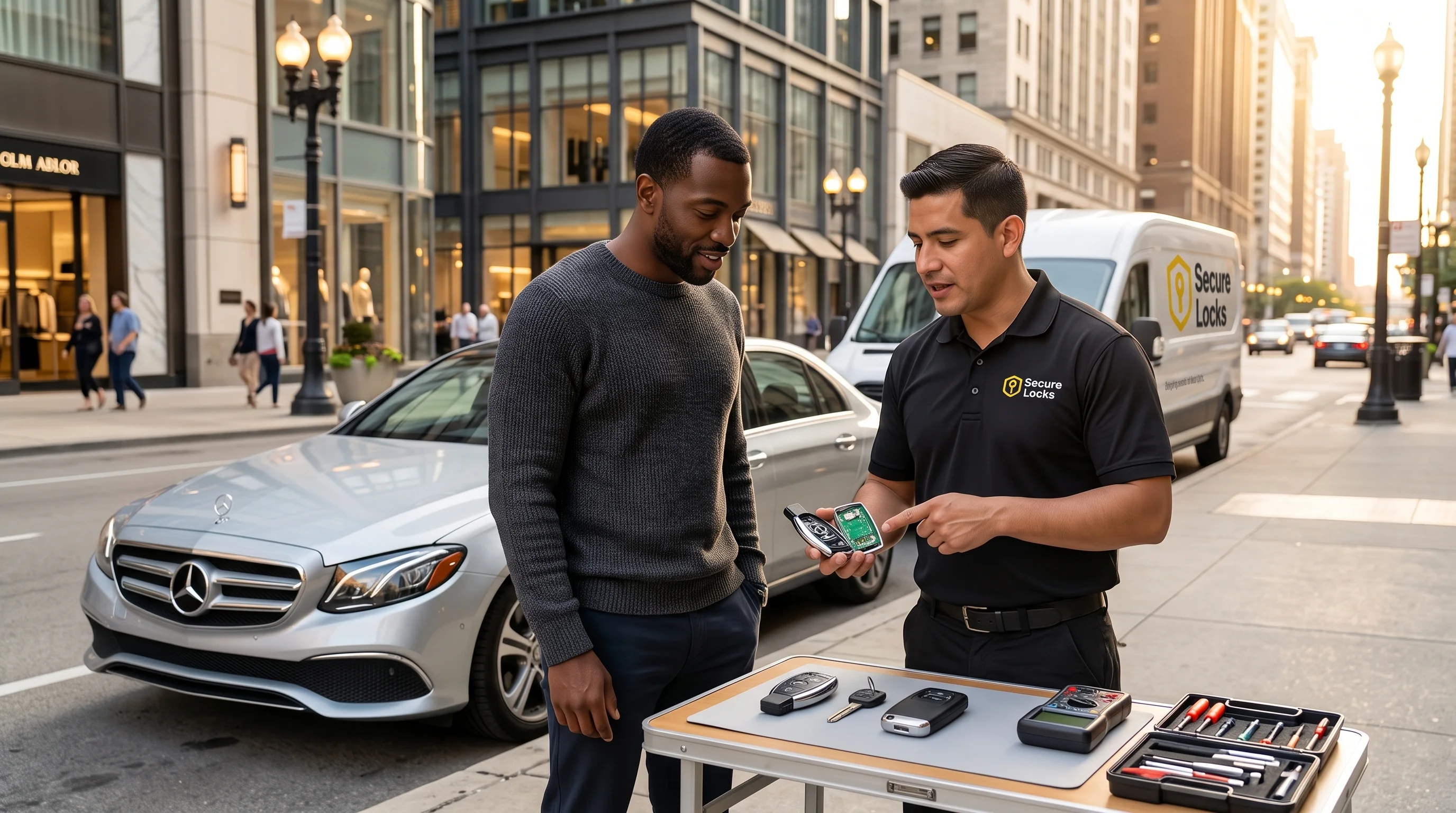
The Mercedes SmartKey is built to last, but it is not indestructible. After years of daily use, the buttons wear down, the chrome edges chip, the battery fades and the internal electronics can start to behave inconsistently. When a SmartKey stops doing its job, owners usually face three possible paths: repair the fob, reprogram it, or replace it entirely. Choosing the right one depends on what has actually failed, and for drivers in Chicago, where cold weather and heavy daily use take a toll on every fob, getting that diagnosis right is the difference between a quick fix and a full car key replacement.
Each option addresses a different kind of failure. Repair handles physical and power problems. Reprogramming addresses certain functional issues where the hardware is still sound. Replacement becomes necessary when the fob is lost, stolen or electronically damaged beyond repair. Knowing which symptoms point to which path saves time and avoids solving the wrong problem.
How the Mercedes SmartKey Works
The SmartKey handles several functions at once. It carries the remote transmitter that sends lock, unlock and trunk commands. It includes the encrypted component that communicates with the car's drive authorization system to allow the engine to start. On vehicles with KEYLESS-GO, it also communicates with antennas around the car so the doors unlock when a handle is touched and the engine starts with the button. Inside the fob sits a coin cell battery and a removable mechanical emergency blade.
Because these functions depend on different parts of the key, a SmartKey can partially fail. It might start the car but not lock it, or unlock the doors with the button but not with keyless entry. Those partial failures offer useful clues about what has gone wrong.
Why Mercedes Keys Are Tied to the Vehicle
Mercedes keys are matched to the vehicle through encrypted data, and many keys are locked to the car they were made for. That design protects against theft, but it also means a SmartKey cannot simply be swapped from one car to another. It is one of the reasons replacement tends to be more involved than repair.
When Repair Is Enough
Repair makes sense when the electronics still work but something physical has failed. The most common example is the battery. A weak battery causes reduced range, inconsistent button response and, on some models, a warning message in the instrument cluster. Replacing it with the battery type specified in the owner's manual often restores normal function immediately. In Chicago winters, a battery that was barely holding on can fail suddenly, so a fresh battery should always be the first thing tried.
Physical damage to the housing is another candidate for repair. A cracked case, worn button covers, broken battery tray or damaged emergency blade can often be addressed by moving the internal board into a new housing or replacing the damaged part. As long as the board itself is healthy, the key keeps its existing programming.
When the Battery Contacts Are the Problem
Sometimes a new battery does not fix the issue because the contacts that touch the battery are corroded or bent. Moisture from snow, rain or a spilled drink can leave corrosion that interrupts power even with a fresh battery. Cleaning or repairing those contacts can bring a fob back to life, but corrosion that has spread across the board usually points toward replacement instead.
Replacing a Worn SmartKey Housing
A SmartKey that has been used every day for many years often shows its age on the outside first. The chrome trim flakes, the button symbols wear away and the housing seams begin to separate. When the electronics are still working correctly, transferring the internal board into a new housing restores the look and feel of the key without changing how it communicates with the car. The emergency blade can usually be moved over or replaced at the same time. The main caution is care during the transfer, since the board inside a SmartKey is small and can be damaged by rough handling. A housing replacement done carefully keeps the original programming intact and avoids the time involved in a full replacement.
When Reprogramming Is the Right Step
Reprogramming, or more accurately resynchronizing or reinitializing certain functions, can help when the hardware is sound but a function has stopped responding correctly. On some models, the remote portion of the key may need to be resynchronized with the vehicle after a battery change or after an extended period without use. The approach varies by generation, and in many cases the owner's manual describes a simple procedure.
It is important to understand what reprogramming cannot do. It cannot restore a key whose internal electronics are damaged, and it cannot convert a key made for another car into one that works for this vehicle. When a key is completely unrecognized by the car, even with a fresh battery and after using the backup start method, reprogramming alone rarely fixes the problem.
Why a Used SmartKey Is Rarely the Answer
Online listings for used Mercedes keys can make replacement look simple. In practice, most Mercedes keys are locked to the vehicle they were originally made for, and a used key from another car generally cannot be accepted by a different vehicle. The key may look identical and even fit the same housing, but the car will not authorize it. Before buying any key, it is worth speaking with a qualified provider who can confirm which key type the car needs and how that key will be matched to the vehicle. That conversation prevents a common and frustrating mistake.
Checking the Car Before Blaming the Key
Some symptoms that look like key failures actually come from the car. A worn ignition switch, a failing electronic steering lock on certain older models, or a problem with the KEYLESS-GO antennas can all produce messages or behavior that seems to point at the key. A careful technician tests both the key and the vehicle before recommending a solution, which avoids replacing a key that was never the problem.
When Car Key Replacement Is the Only Real Option
Replacement becomes necessary when the fob has been lost or stolen, when the internal board has been damaged by water or impact, or when repeated repairs have not resolved intermittent failures. A replacement SmartKey must be matched to the vehicle, and the method depends on the car's security generation. On some older systems, a qualified locksmith can prepare a key on site using specialized equipment. On many newer vehicles, keys are produced for the specific vehicle identification number and initialized once they arrive.
What the Replacement Process Involves
The process begins with verifying ownership through a photo ID and the title or current registration. The vehicle identification number identifies the security generation and the correct key type. Once the key is prepared or received, the emergency blade is cut to match the car's locks, and the key is initialized with the vehicle.
Disabling the Lost Key
If a SmartKey was lost or stolen, the missing key should be disabled so it can no longer operate the car. Mercedes systems allow keys to be locked out, and doing so when the new key is added restores full security. This step matters in any situation where the key could have ended up in someone else's hands.
Testing Every Function After Replacement
Every function should be tested before the job is complete: remote lock and unlock, trunk release, keyless entry and start where equipped, and the emergency blade in the driver's door. On KEYLESS-GO vehicles, it is worth testing keyless entry at more than one door, since each door may rely on its own antenna.
Mercedes SmartKey Car Key Replacement in Chicago
Chicago driving creates its own patterns of SmartKey wear. Short winter trips, frequent use in cold weather and keys that spend long days in coat pockets all contribute to battery drain and wear on buttons. Keys dropped into slush or snowbanks may work for a few weeks before corrosion causes failures. Theft is also a concern in busy areas, where a key can disappear along with a bag or a jacket.
When a SmartKey fails completely, the location of the car matters. A car in a private garage gives the owner time to arrange a replacement, while a car on a restricted Chicago street may need to be moved quickly to avoid tickets or towing during street cleaning or snow route enforcement. Having a working spare removes that pressure entirely.
A Simple Order of Troubleshooting
The most efficient approach follows a clear order. The first step is a fresh battery of the correct type. The second is checking the housing, contacts and emergency blade for visible damage. The third is trying the backup start method described in the owner's manual to see whether the car recognizes the key at close range. If the key still fails after these checks, a professional inspection can determine whether the fob can be repaired, whether a function can be restored, or whether car key replacement is the dependable path.