

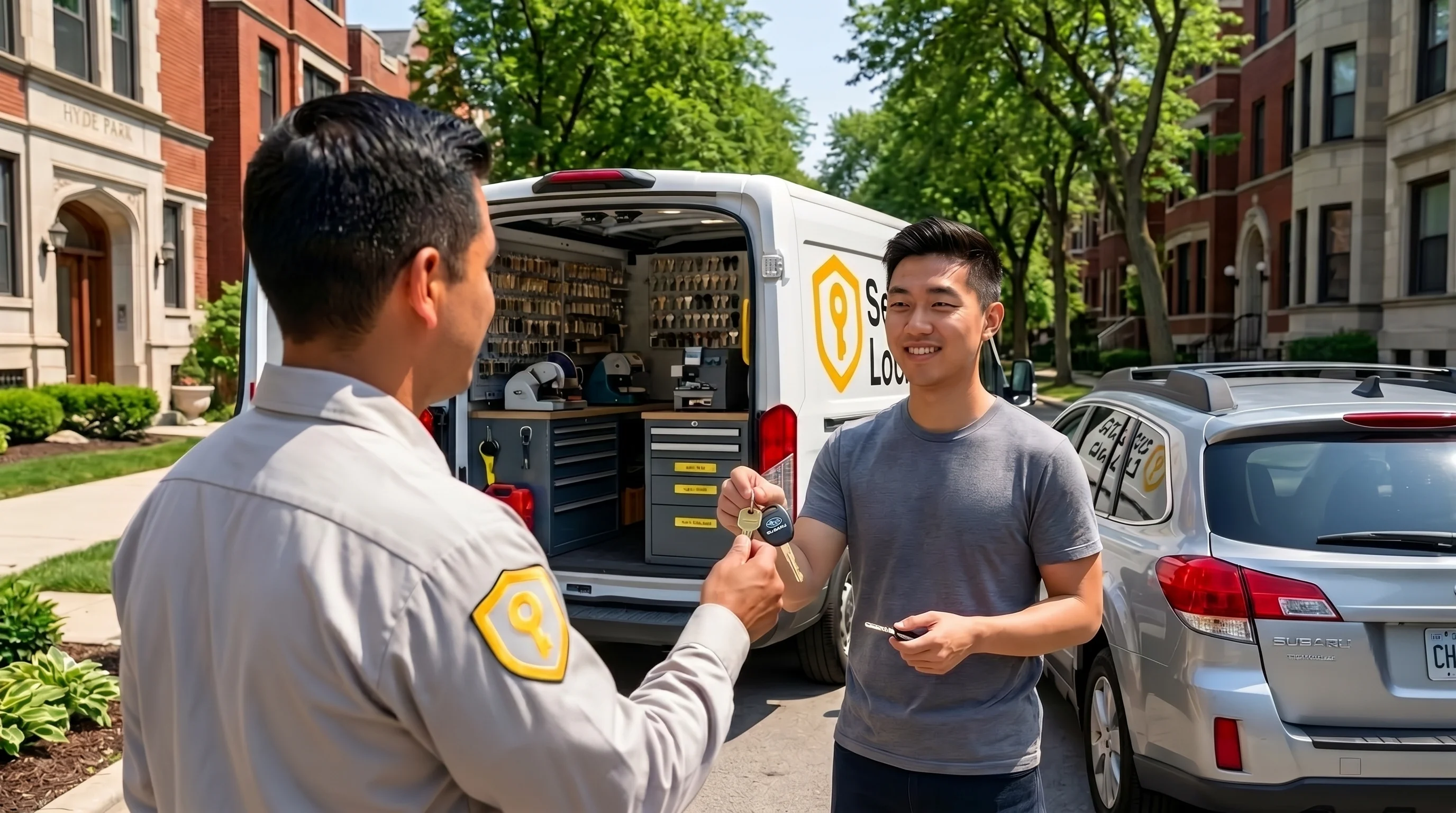
Losing a car key does not always create an immediate emergency. If another working key is available, the vehicle still unlocks, starts, and fits into the normal routine. That temporary sense of security can make replacing the missing key feel easy to postpone. The problem is that once only one functional key remains, there is no longer a true backup. Losing, damaging, or electronically disabling that final key can turn a simple duplication task into a much more disruptive vehicle-access problem.
For Chicago drivers, the risk is especially practical. A car key can disappear between a parking garage and an office, fall from a pocket during errands, remain behind in a restaurant, or become damaged during everyday use. Choosing to copy keys while a dependable original is still available restores redundancy before another unexpected event leaves the vehicle without a usable key.
Modern automotive keys also make timing more important. Depending on the vehicle, a duplicate may require more than cutting metal. Transponder chips, remote functions, proximity technology, and immobilizer authorization can all be part of the process. Understanding those differences helps explain why waiting until the last key disappears is rarely the most convenient strategy.
Why Drivers Should Copy Keys While One Working Original Still Exists
A functional original key provides valuable information. Its blade pattern, electronic behavior, remote functions, and interaction with the vehicle can all serve as references when another key is created. When the original is still working normally, the new key can also be compared directly with it and tested before being relied upon as a backup.
Once every working key is gone, the situation changes. There is no spare to test against, no functioning key to use temporarily, and no immediate way to drive the vehicle. What was once preventive duplication can become a full car key replacement situation involving identification, cutting, programming, and verification before the vehicle becomes usable again.
Copy Keys Before the Remaining Original Becomes the Only Point of Failure
Two working keys create redundancy. One working key creates dependence. That difference is easy to overlook because the vehicle behaves exactly the same while the remaining key is still available.
The risk becomes obvious only when something happens to that last key. It may be dropped somewhere in downtown Chicago, damaged inside a bag, exposed to moisture, cracked at the housing, or simply misplaced at home. Electronic keys can also fail even when they remain physically present.
Drivers do not need to predict which failure will happen. The purpose of choosing to copy keys early is to make sure a single failure does not eliminate access to the vehicle.
Copy Keys Before Everyday Wear Damages the Best Reference
Car keys experience more physical stress than many drivers realize. They are dropped, twisted, carried alongside other metal objects, exposed to temperature changes, and used hundreds or thousands of times over their lifespan. Folding keys can loosen around the hinge, plastic housings can crack, and mechanical blades can gradually wear.
Creating a duplicate while the original remains in good condition can be preferable to waiting until the only available key is already worn or damaged. A clean, reliable reference makes it easier to verify that the new key performs as intended.
Why Modern Vehicles Make It More Important to Copy Keys Early
Older automotive keys were primarily mechanical. The correct blade pattern could operate the lock and ignition, making duplication relatively straightforward. Many modern vehicles use additional electronic security that changes what a functional copy must accomplish.
A key may contain a transponder chip that communicates with the immobilizer, remote buttons that control the locks, or proximity electronics that allow push-button starting. In these systems, physical appearance alone does not determine whether a duplicate will work.
Copy Keys With Transponder Technology in Mind
A transponder key contains an electronic chip that the vehicle checks before authorizing the engine to start. The blade may be cut correctly and still fail to operate the vehicle if the transponder is missing, incompatible, damaged, or not properly programmed.
This explains why a duplicate can unlock the door yet fail at the ignition. The mechanical portion has passed one test, but the electronic security system has rejected another.
Chicago drivers who want to copy keys for transponder-equipped vehicles should therefore think in terms of complete functionality. A backup needs to do more than fit the lock; it should also be recognized by the vehicle when starting is attempted.
Copy Keys Correctly for Push-to-Start Vehicles
Push-button-start vehicles rely even more heavily on electronic recognition. A smart key or proximity fob communicates wirelessly with the vehicle, allowing the driver to unlock and start the car without inserting a conventional key into the ignition.
A visually identical replacement does not automatically contain the correct electronics or programming. The vehicle must recognize the fob as an authorized key.
This is why duplicating modern keys often overlaps with car key replacement. The objective is not merely to reproduce an object that looks like the original; it is to create another credential that the vehicle accepts reliably.
Copy Keys Before a Missing Original Turns Into an All-Keys-Lost Situation
Losing one of two keys changes the risk profile immediately. The remaining key still solves the immediate problem, but there is no longer a fallback if anything happens to it.
Drivers sometimes spend months telling themselves that the missing original may eventually turn up. Occasionally it does. In other cases, the search is gradually abandoned while the remaining key continues carrying the full responsibility for the vehicle.
Copy Keys Instead of Depending on a Key That May Already Be Missing Permanently
A key misplaced somewhere inside the house is different from one that disappeared during a day across Chicago. The larger the search area becomes, the less realistic it may be to assume the key will eventually return.
After checking the obvious locations, retracing recent steps, and allowing reasonable time for the key to be found, restoring a backup can be more practical than continuing indefinitely with only one working key.
The purpose is not to declare the original permanently lost. It is to reduce dependence on finding it.
Copy Keys Before the Final Key Is Lost Outside the Home
The consequences of losing the only key depend heavily on where it happens. Losing it in a familiar home environment may allow more time to investigate alternatives. Losing it in a downtown Chicago garage, shopping center, airport parking area, or unfamiliar neighborhood immediately creates transportation and access complications.
A working spare stored securely in a separate location gives the driver another option. Even if retrieving it takes some effort, that is very different from having no functioning key at all.
Common Reasons Chicago Drivers Lose Their Only Remaining Key
Most lost-key situations are not dramatic. Keys simply move through dozens of small transitions every day: vehicle to pocket, pocket to desk, desk to bag, bag to restaurant table, and back again. The more places a key travels, the more opportunities exist for it to be left behind.
Chicago lifestyles can add additional transitions. Drivers move between street parking, office buildings, apartment entrances, parking garages, stores, restaurants, public transportation connections, and rideshares. A key that disappears somewhere along that route can be surprisingly difficult to recover.
Copy Keys Before Busy Routines Make the Last Key Harder to Track
A key that is always stored in the same place is easier to manage. Problems begin when daily routines become inconsistent. Someone may place the key in a coat pocket one day, backpack the next, and kitchen counter after that.
Having a spare does not eliminate the need for good habits, but it reduces the consequences of one lapse. A duplicate kept separately provides a recovery option while the missing key is being searched for.
Copy Keys Before Travel Creates Another Opportunity for Loss
Airport trips are especially unforgiving because drivers often handle luggage, identification, phones, boarding information, and multiple bags at the same time. A car key may be tucked into an unfamiliar pocket or bag once the vehicle is parked and then forgotten during the trip.
Returning to Chicago after several days away only to discover that the vehicle key is missing can create an immediate access problem. A secure backup can make that situation much easier to manage.
Copy Keys Before Physical Damage Makes the Original Unreliable
Loss is only one reason to maintain a duplicate. A key can remain in the driver’s possession and still become unusable.
Mechanical blades can bend, folding mechanisms can loosen, housings can crack, and remote buttons can become inconsistent. Moisture exposure can affect internal electronics, while repeated drops can damage components that are not visible from the outside.
Copy Keys When the Key Housing Starts Cracking
A cracked shell may initially appear to be a cosmetic issue, especially when the buttons continue working. The housing, however, protects the transponder, circuit board, battery, and other components from movement and contamination.
As the crack grows, internal parts may shift or become exposed to moisture. The key can continue working until the damage reaches a point where it suddenly does not.
If the only working key already shows visible physical deterioration, restoring a backup becomes more important. Waiting until the housing separates completely removes the advantage of acting while a functioning reference still exists.
Copy Keys Before a Bent Blade Breaks in the Lock
A bent blade should not be repeatedly forced into the door or ignition. Each use places additional stress on already deformed metal and may also increase wear inside the lock cylinder.
If the blade breaks while it is inserted, the driver now has two problems: a broken key and a fragment that may need to be extracted from the lock or ignition.
For Chicago drivers who notice increasing resistance or visible bending, creating another working key and addressing the cause of the resistance is more sensible than depending on the damaged original indefinitely.
Why Chicago Weather Makes a Reliable Spare More Valuable
Chicago weather does not automatically cause car keys to fail, but it can expose weaknesses that were already developing. Cold temperatures can make weak fob batteries more noticeable, while snow, rain, and moisture can create additional problems for damaged electronic housings.
Physical locks can also become more difficult to operate during winter, particularly when moisture or contamination is already present.
Copy Keys Before Chicago Winter Reveals a Weak Fob
A fob that already has reduced range or inconsistent button response may become noticeably less dependable during cold weather. Replacing the battery is a logical first step, but continued problems can indicate an issue beyond normal battery depletion.
If that fob is the only remaining key, every intermittent failure becomes more significant. Creating and testing a dependable spare before winter reduces reliance on a key that has already started behaving unpredictably.
Copy Keys Before Moisture Reaches Damaged Electronics
Cracked fobs and loose battery covers provide easier pathways for moisture to reach sensitive components. Rain, melting snow, wet gloves, spilled drinks, or ordinary condensation can become more consequential when the protective housing is compromised.
A key does not always fail immediately after moisture exposure. Intermittent symptoms may appear first, including buttons that respond inconsistently or a vehicle that occasionally fails to detect the fob.
Copy Keys and Test the New Spare Before Depending on It
Creating the duplicate is only part of the process. A spare should be tested before it is stored away because a backup that has never been verified creates a dangerous assumption.
The exact test depends on the key type. A traditional blade should operate smoothly. A transponder key should start the vehicle consistently. A remote should control the intended locks, and a proximity fob should be recognized without repeated warnings.
Copy Keys and Verify Every Function
Drivers should not stop testing after the new key unlocks the door. If the original provides remote lock, unlock, trunk, panic, proximity, or push-to-start functions, the duplicate should be checked according to the features it is intended to reproduce.
This is particularly important with modern keys because mechanical and electronic functions can fail independently. A spare that unlocks the car but cannot start it is incomplete for most drivers.
Copy Keys and Keep the Duplicate Separate From the Original
Keeping both keys together eliminates much of the purpose of duplication. If two keys are attached to the same ring or carried in the same bag, losing that one item can remove both at once.
A spare should be stored in a secure, separate location that can be accessed when needed. Chicago households with multiple drivers may also benefit from establishing clearly where the backup is kept so it does not become another “missing” key.
When Copy Keys Becomes a Car Key Replacement Issue
There is a practical difference between making an additional spare and replacing a key that no longer exists. If one reliable original is available and another is being created for redundancy, the situation is straightforward duplication. If all working keys are gone, the task has shifted into car key replacement.
That distinction can affect how the key is identified, cut, programmed, and verified. An all-keys-lost situation may require the vehicle itself to become the primary reference.
Copy Keys Before Losing the Last Key Preserves More Options
The presence of one functioning key gives the driver flexibility. The vehicle remains usable while the duplicate is being arranged, and the new key can be compared directly with the existing one.
Once the last key is gone, that flexibility disappears. The vehicle stays where it is until another authorized key can be created or recovered.
Copy Keys While the Original Still Starts the Vehicle Reliably
Intermittent starting problems should be treated as an early warning. If the vehicle occasionally displays “key not detected,” requires several attempts, or only recognizes the fob in certain positions, the current key should not automatically be considered dependable just because it eventually works.
A consistently functioning backup offers a safer margin than relying entirely on an increasingly unpredictable original.
Copy Keys Before a Preventive Task Becomes an Urgent One
There is a fundamental difference between choosing when to create a spare and being forced to solve a lost-key problem immediately. Preventive duplication happens on the driver’s schedule. An all-keys-lost situation happens wherever and whenever the last key disappears.
For anyone who depends heavily on a vehicle in Chicago, maintaining control over that timing is one of the strongest reasons to keep more than one functional key.
Copy Keys Without Assuming Every Duplicate Works the Same Way
Automotive technology varies widely across manufacturers, model years, trims, and ignition systems. Two keys that look nearly identical can contain different electronics, frequencies, or transponder technology.
Accurate vehicle information therefore matters. Year, make, model, ignition style, and existing key type help determine what the duplicate needs to accomplish.
Copy Keys Based on Vehicle Compatibility, Not Appearance Alone
A replacement fob purchased simply because it resembles the original may not communicate correctly with the vehicle. Likewise, a blank key that physically fits may use the wrong transponder technology.
Successful duplication depends on compatibility inside the key as much as on appearance outside it.
Copy Keys With the Vehicle’s Security System in Mind
Modern immobilizers exist specifically to prevent unauthorized keys from starting the vehicle. Any duplicate intended to operate the engine must satisfy the system’s security requirements.
That may involve programming or registration in addition to mechanical cutting. This is another reason a complete car key replacement process can be more involved than copying an ordinary mechanical key.
A Spare Key Should Remain Ready After You Copy Keys
Once another key exists, it should not be forgotten indefinitely. Electronic fob batteries gradually discharge, and keys stored for years may not remain in the same condition they were in when first created.
Periodic testing keeps the backup from becoming an assumption.
Test the Spare Occasionally After You Copy Keys
A quick functional check can confirm that the spare still unlocks and starts the vehicle. For smart keys, remote and proximity functions should also respond normally.
Chicago drivers who keep a spare primarily for emergencies may go years without using it. Testing occasionally ensures that the first use after a long period is not during an actual lockout.
Replace Weak Fob Batteries Before the Spare Is Needed
A dead fob battery is a relatively simple problem when discovered in advance. It becomes much more frustrating when the spare is being retrieved because the primary key has already been lost.
Keeping electronic backups functional is part of maintaining real redundancy.
Copy Keys Before One Missing Key Becomes a Much Bigger Chicago Problem
Losing the first key should be treated as a warning, not merely an inconvenience that has already passed. The remaining key may work perfectly today, but it has become the only point of access and starting authorization for the vehicle.
Choosing to copy keys restores the margin that disappeared when the original was lost. It also gives Chicago drivers more flexibility if the everyday key is later damaged, misplaced, electronically unreliable, or left somewhere far from the vehicle.
The key does not need to be failing before action makes sense. In fact, the most convenient time to create a backup is usually while the current key works normally, the vehicle is accessible, and there is no immediate pressure to solve the problem. If the final key is already missing or unusable, car key replacement becomes the next step for restoring dependable vehicle access.
Chicago traffic, weather, parking garages, airport trips, and everyday schedules create enough variables without depending entirely on a single key. Maintaining a tested spare turns a future lost-key event from a potential immobilization problem into a situation with another practical option.