

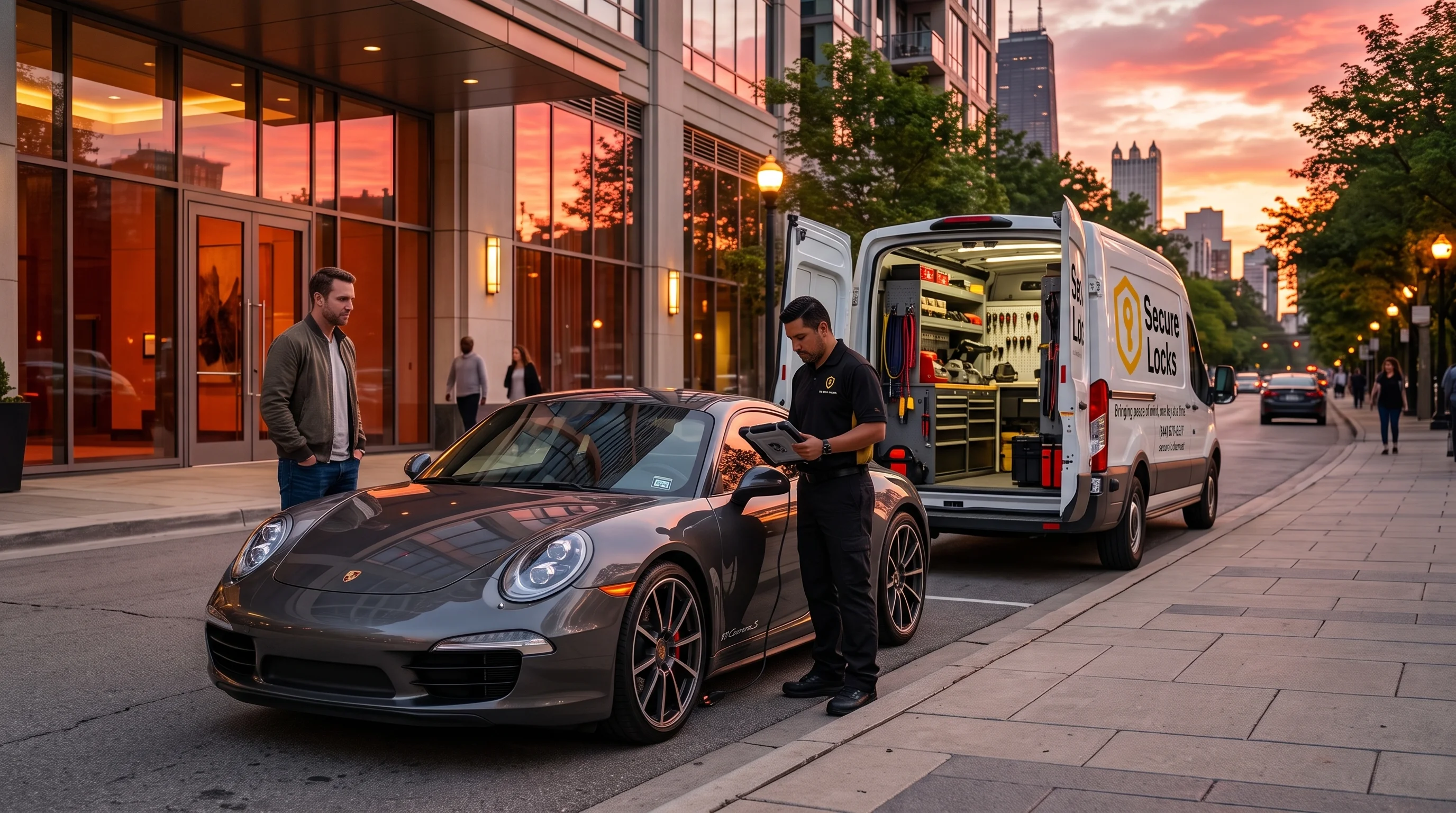
Losing one Porsche key is an inconvenience. Losing every key is a different problem altogether. With no working key available, the car has nothing to copy from and no authorized key to vouch for a new one, which means the replacement process has to start from the vehicle itself. For Porsche owners in Chicago facing an all keys lost situation, knowing what has to happen before a new key works makes it easier to choose the right provider, gather the right documents and avoid delays that keep the car off the road longer than necessary.
This situation is usually called "all keys lost" in the automotive locksmith world, and it is one of the more involved forms of car key replacement. The good news is that it is solvable. The steps simply need to happen in the right order, and the approach depends on the model, the year and how the car's security system is built.
Why an All Keys Lost Situation Is Different
When at least one working key exists, a new key can often be added through a process where the car already recognizes an authorized key. The existing key helps confirm that the person adding a new one has legitimate access. When no key is available, that shortcut disappears. The new key has to be created using information stored in the car's own modules, or it has to be produced for the vehicle through the manufacturer.
Porsche vehicles use immobilizer systems that store encrypted key data in one or more control units. The transponder in each key must match that data before the engine management system will allow the car to start. Without an existing key, the technician has to access that data safely and correctly, which requires specialized equipment, experience with Porsche systems and, sometimes, additional steps on the bench.
Model Differences Across the Porsche Range
A 911 from the late 1990s, a first generation Cayenne, a Panamera and a current Macan all handle key security in different ways. Some older models rely on simpler transponder systems that are well supported by independent tools. Mid-generation vehicles often share architecture with other brands in the same group, which can make certain procedures more familiar to experienced technicians. The newest models tend to tighten security further, and some of those may require working through the manufacturer. Confirming the exact model and year is the first technical step in any Porsche key job.
The Steps Before a New Porsche Key Works
Although the details change between models, most all keys lost cases follow the same basic sequence. Each step exists for a reason, and skipping one usually causes problems later. Understanding the order also helps owners see why the job cannot be rushed, since each stage depends on the one before it being done correctly and verified before moving on.
Proving Ownership
Before any work starts, the owner must prove that the car belongs to them. A valid photo ID and the title or current registration are the standard documents. This requirement protects owners, since any provider willing to make a key without verification would be willing to make one for someone who does not own the car. When the documents are ready at the start, the rest of the process moves faster.
Accessing the Immobilizer Data
With ownership confirmed, the technician identifies the security system and determines how to obtain the data needed for a new key. On some vehicles this can be done through the diagnostic port. On others, a control unit may need to be accessed directly, which can involve removing it from the car temporarily. This is careful work, and it is one of the reasons an all keys lost job takes longer than simply adding a spare.
Preparing and Cutting the New Key
Once the data is available, a compatible key is prepared and loaded with the information the car expects. The mechanical emergency blade, which opens the driver's door when the battery is dead, is cut to match the vehicle's locks. When no original key exists to copy, the blade is cut by code or by decoding the lock. Both methods produce an accurate cut when done correctly.
Programming, Testing and Removing Lost Keys
The final stage is programming the new key to the car and testing every function. That means remote lock and unlock, trunk or frunk release, keyless entry and start where equipped, and the emergency blade in the driver's door. At the same time, any keys that were lost should be removed from the car's memory. If a lost key turns up later in the wrong hands, it will no longer work.
Where the Car Is Matters in Chicago
An all keys lost situation often happens at the worst possible moment. A key disappears at a lakefront event, gets left behind in a restaurant downtown, or vanishes from a coat at a crowded gathering. The car is then sitting somewhere it may not be able to stay for long. In Chicago, that can mean metered street parking, a garage that charges overnight, or a residential street with permit restrictions and seasonal parking bans during snow events.
When the car cannot move, the location shapes the solution. A provider that can perform the work on site avoids the need to tow a car that cannot start. When the work requires the manufacturer route, the car may need to be transported to a service facility. Knowing which route applies early in the process helps the owner plan around parking rules and timelines instead of reacting to them.
Towing Versus On-Site Work
Towing a Porsche is not the same as towing an ordinary car. Many models sit low, some have all-wheel drive, and a vehicle that cannot be placed in neutral without a working key complicates things further. A flatbed is typically required. When a qualified locksmith can create a key where the car is parked, the owner avoids that entire process. When towing cannot be avoided, it should be arranged with a carrier experienced with low vehicles.
Car Key Replacement Choices for Porsche Owners
In an all keys lost situation, the owner generally has two paths. One is the dealership, which works through the manufacturer and is often the reliable option for the newest models. The other is an automotive locksmith equipped for Porsche and related platforms, which can often handle the job on site for supported models and avoid the need to move the car.
Each path has tradeoffs. The dealership route may involve ordering a key for the vehicle and scheduling the car for programming, which can take several days. A qualified locksmith can often complete the work more quickly for supported vehicles. The deciding factors are the model year, the security system, the car's location and how quickly the car needs to be back in service.
Questions That Clarify the Right Route
A few questions help sort out the options quickly. Can the job be completed where the car is parked? Does the provider regularly work on this Porsche model? Will lost keys be removed from the system? Which functions will the new key support? Clear, specific answers are a good sign that the provider understands the vehicle.
Preventing the Next All Keys Lost Situation
The simplest way to avoid repeating this experience is to keep at least two working keys at all times. Once the car is running again, adding a second key while one works is far easier than going through the all keys lost process again. The spare should be stored somewhere safe and separate from the main key, not on the same ring and not in the car.
Keeping a Spare After Car Key Replacement
Where the spare lives matters as much as having one. A second key kept in a desk at home is useful when the main key goes missing on a weekday, but far less useful when the car is parked at a stadium lot and home is across the city. Some owners keep the spare with a trusted family member, others at home in a drawer that everyone in the household knows about. The point is that the spare should be reachable within a reasonable time from the places the car is usually driven. For drivers who commute into Chicago from the suburbs, that might mean keeping the spare at home while making sure a household member can bring it downtown if needed.
It is also worth checking the spare every few months. A spare key that has been sitting in a drawer for a long time may have a dead battery, and discovering that during an emergency defeats the purpose. Pressing the buttons near the car and confirming the key is recognized for starting takes only a minute.
For Porsche owners across Chicago, the lesson from an all keys lost event is usually the same. The car can be recovered, but it takes the right equipment, the right documents and the right sequence of steps. Preparing those in advance, and choosing a provider that understands Porsche security, is what turns a stressful situation into a manageable car key replacement.