

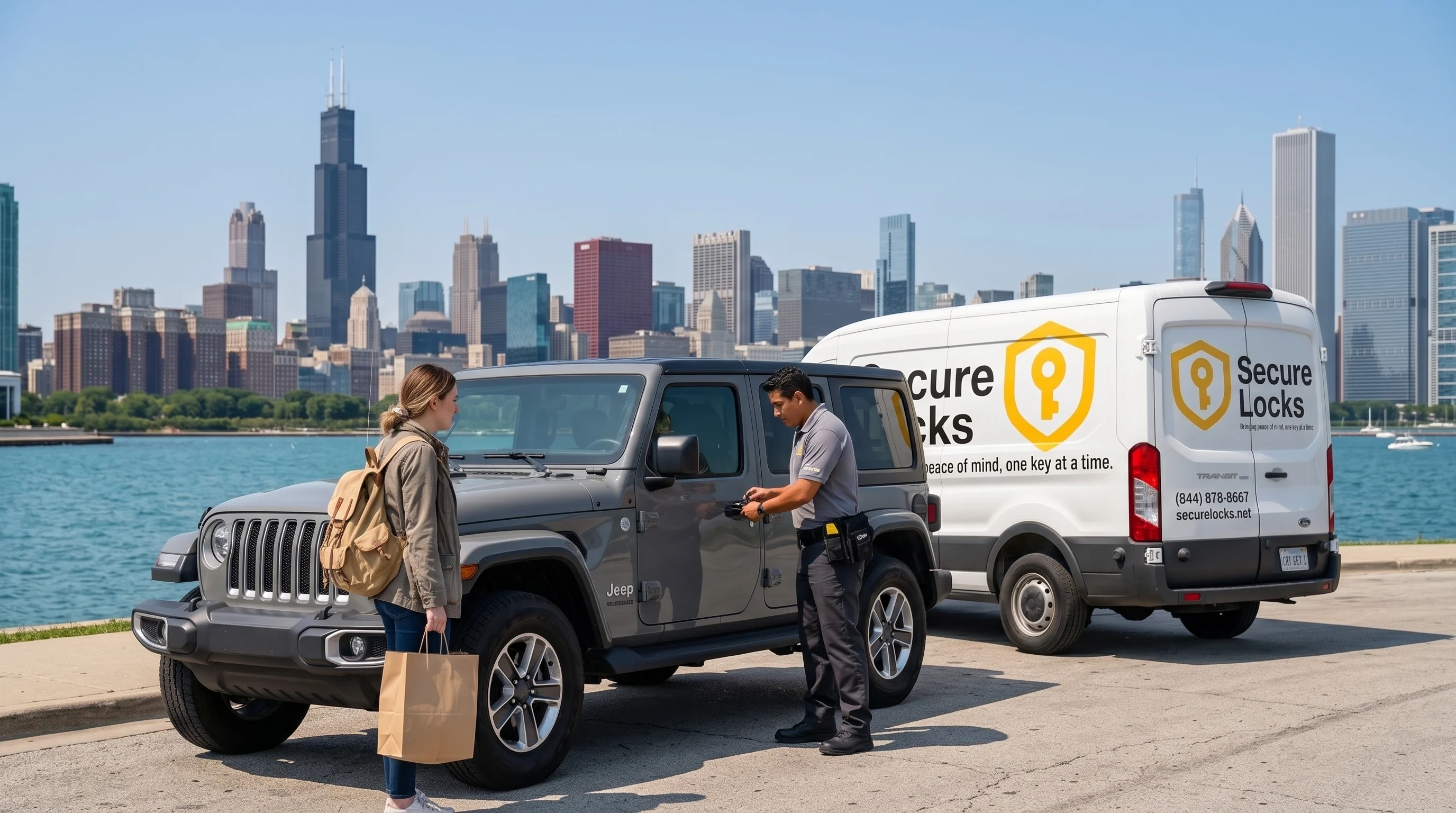
A vehicle lockout is inconvenient anywhere, but the situation feels very different when it happens miles from home. The keys may be sitting on the front seat, a key fob may suddenly stop responding in a parking garage, or the only key may disappear somewhere between errands. At that point, getting back to a spare stored at home may not be realistic, and moving the vehicle without resolving the key problem may be impossible.
For drivers in Chicago, those situations can unfold in downtown garages, shopping centers, office parking lots, airport areas, residential streets, or unfamiliar neighborhoods. A mobile locksmith can be particularly useful because the service is built around addressing the problem where the vehicle is located rather than requiring the vehicle to be moved first. When the issue involves automotive locks, keys, fobs, or ignition access, choosing a qualified car locksmith can also help ensure that the solution matches the security system used by the vehicle.
When a Mobile Locksmith Makes More Sense Than Trying to Get Home
Not every key problem requires on-site assistance. If a reliable spare is nearby and someone can bring it quickly, that may be the simplest answer. The decision changes when the spare is far away, no spare exists, the key is damaged rather than missing, or the vehicle does not recognize the available fob.
A mobile locksmith becomes more practical when solving the problem at the vehicle is easier than arranging another way to retrieve a key or transport the car. This is especially relevant with modern vehicles because a replacement may require more than opening the door. Cutting a blade, programming a transponder, configuring a key fob, or diagnosing an ignition problem may all need to happen before the vehicle can be driven again.
A Mobile Locksmith Can Help When the Keys Are Locked Inside
Locking keys inside a vehicle remains one of the most familiar automotive access problems. Sometimes the keys are visible on a seat or center console. In other cases, they are trapped in the trunk, a backpack, or another area that cannot be reached without first unlocking the vehicle.
The temptation to improvise can be strong, particularly when the driver can see the keys through the window. However, modern doors contain weather seals, wiring, side-impact components, electronic locks, and other systems that make forceful entry a poor experiment. Improvised tools can scratch paint, damage weather stripping, interfere with internal lock components, or create a larger repair problem than the original lockout.
A mobile locksmith allows the driver to address the lockout at the vehicle without first finding transportation across Chicago to retrieve another key. When the keys are safely recovered and function normally, no replacement may be necessary at all.
A Mobile Locksmith Is More Useful When No Spare Exists
The situation changes considerably when the missing key is the only key. Opening the door solves access to the interior, but it does not necessarily solve the ability to start the vehicle. If the original key cannot be recovered, another functional key may need to be created.
That can involve identifying the correct key type, cutting a blade when applicable, programming a transponder, or pairing a smart key with the vehicle. In this scenario, the value of mobile service is not simply that someone can unlock a door. The more important advantage is that the automotive key problem can potentially be handled where the vehicle is already stranded.
Why a Mobile Locksmith Is Different for Modern Vehicles
Automotive lockouts have changed as vehicle security technology has evolved. A traditional mechanical key primarily had to match the physical cuts inside the lock and ignition. Many modern vehicles add immobilizers, transponders, remote-entry systems, proximity sensors, and push-button starting.
As a result, a mobile locksmith working on vehicles may need equipment for both mechanical access and electronic key work. The correct solution depends on the vehicle and the reason the driver cannot use it.
A Mobile Locksmith May Need to Address Electronic Key Failure
A driver does not need to lose a key to become stranded. A key fob can be physically present while the vehicle refuses to recognize it. The remote may stop unlocking the doors, a “key not detected” warning may appear, or the vehicle may unlock but refuse to start.
A weak fob battery is one possible explanation, and checking or replacing the battery is often worthwhile. When the problem continues, however, the issue may involve the fob, transponder, programming, proximity system, receiver, immobilizer, or another vehicle component.
For a Chicago driver standing beside a vehicle that will not recognize its key, the distinction matters. Simply retrieving another battery or mechanically opening the door may not restore starting authorization.
A Mobile Locksmith Can Be Useful for Broken Car Keys
Physical keys can also fail far from home. A blade may crack or snap, a folding key may separate at the hinge, or the plastic housing around a fob may break badly enough that the electronics become exposed.
If part of a key breaks inside a door lock or ignition, pulling at the fragment with improvised tools can push it farther into the cylinder or damage internal components. A car locksmith can approach extraction and replacement as related problems rather than treating the broken fragment as the only issue.
The goal is not merely to remove the piece. The remaining key condition, lock condition, and need for another working key should also be considered before the vehicle is returned to normal use.
Chicago Driving Conditions Make Mobile Locksmith Service Particularly Practical
Chicago creates several scenarios where traveling home for a spare may be far less convenient than it sounds. A vehicle could be parked downtown while the spare sits in a home on the opposite side of the city. The problem could happen after a long commute, during an airport trip, or in a garage where leaving the vehicle creates another logistical problem.
Distance is not the only factor. Traffic, parking restrictions, weather, transit connections, and daily obligations can all influence whether retrieving another key is actually the fastest practical option.
A Mobile Locksmith Can Help in Chicago Parking Garages
Parking garages add their own complications. Vehicles may be several levels underground or inside structures where access, clearance, lighting, and cell reception vary. A driver who discovers a lockout after returning from work or an event may also be dealing with garage operating rules and limited options for leaving the vehicle overnight.
If the key is inside the vehicle, on-site unlocking may be enough. If the key has been lost entirely, the situation may require replacement or programming. Understanding which problem exists before choosing a solution can prevent wasted effort.
A Mobile Locksmith Can Be Useful After a Key Is Lost Downtown
A key lost while walking through downtown Chicago can be particularly difficult to recover because the potential search area may include sidewalks, offices, restaurants, stores, garages, rideshares, and public spaces. Retracing every step may be worthwhile initially, but at some point the probability of finding the key becomes low enough that another solution is needed.
When no spare is reasonably accessible, mobile automotive assistance can reduce the number of moving parts in the situation. Instead of arranging transportation away from the vehicle, searching for a spare, and then returning to the original parking location, the key issue can be assessed where the car is parked.
Chicago Weather Can Make Waiting on a Key Problem More Serious
A lockout is more than an inconvenience when weather conditions become uncomfortable or unsafe. Chicago can experience intense cold, snow, rain, strong winds, summer heat, and sudden weather changes, all of which affect how long a driver reasonably wants to remain outside a disabled vehicle.
Weather can also expose existing weaknesses in a key fob. Cold conditions may make a weak battery more noticeable, while moisture can create problems for damaged electronics. A fob that was already unreliable may seem to fail suddenly when conditions become more demanding.
When a Mobile Locksmith Is the Smarter Choice After Losing a Key
Losing a key and locking a key inside the vehicle are two different problems. A lockout may end the moment the existing key is recovered from the cabin. A genuinely lost key can require a new means of starting the vehicle.
This is where the automotive specialization of a car locksmith becomes important. Modern replacement keys may require both a correctly cut mechanical component and electronic authorization before the vehicle will operate normally.
A Mobile Locksmith Can Address More Than Vehicle Entry
Opening the door is often only the first stage when the original key is missing. Depending on the vehicle, a replacement may require a transponder chip, remote functions, a proximity fob, or programming that allows the immobilizer to recognize the new key.
This is why drivers should describe the situation accurately when requesting help. “Locked out” can mean the key is visible inside the car, completely lost, broken in the lock, or physically present but electronically dead. Each scenario points toward a different solution.
A Mobile Locksmith Should Know Whether the Original Key Still Exists
One of the most useful pieces of information is whether the original key can still be located. If it is locked inside the vehicle, unlocking may restore full operation. If the key has disappeared, a replacement may be required. If the key is present but damaged, repair or replacement decisions may depend on which component failed.
Knowing whether a spare exists is equally important. A spare stored across Chicago may still be useful, but its location and condition determine whether retrieving it makes practical sense.
A Mobile Locksmith Visit Is Easier When Vehicle Details Are Ready
Accurate vehicle information can help identify the likely key system before work begins. The year, make, model, ignition type, and whether the vehicle uses a traditional key or push-button start are particularly relevant.
Drivers should also be prepared to establish their right to access the vehicle. Automotive security exists for a reason, and legitimate vehicle access should be handled with appropriate ownership or authorization verification.
When a Mobile Locksmith May Not Be the First Thing to Call
Mobile automotive assistance is useful, but not every roadside problem is actually a locksmith problem. If the vehicle has electrical power loss, a dead starter battery, mechanical engine failure, a flat tire, collision damage, or another non-key issue, roadside or mechanical assistance may be more appropriate.
The challenge is that some symptoms overlap. A vehicle that will not start may have a key-recognition problem, but it could also have a battery or mechanical issue. A door that will not unlock remotely could indicate a dead fob battery, yet it might also relate to the vehicle’s electrical system.
A Mobile Locksmith Fits Problems Involving Access, Keys, and Ignition Security
The strongest signs of an automotive locksmith issue involve the key or locking system directly. Keys locked inside, lost keys, broken blades, failed transponders, damaged fobs, jammed locks, key extraction, and certain ignition-cylinder problems all fall closer to that category.
When the engine cranks normally but fails for unrelated mechanical reasons, replacing or programming a key is unlikely to solve the problem. Correctly identifying the symptom prevents the driver from pursuing the wrong kind of assistance.
Avoiding Damage While Waiting for a Mobile Locksmith
Being able to see the key through the window can make forced entry feel deceptively simple. Online videos may also make improvised unlocking techniques look easier than they are because they rarely show the damaged weather seal, scratched trim, bent lock components, or deployed security systems that can result from a failed attempt.
Modern vehicles are designed to resist unauthorized entry. That is beneficial for security, but it means forcing a door or manipulating internal components without understanding their location can create unintended damage.
Do Not Force a Door Because the Mobile Locksmith Has Not Arrived Yet
Pulling the top of a door frame outward, inserting improvised wedges, or pushing rigid objects through seals can alter alignment and damage components. Even if the door eventually opens, water leaks, wind noise, cosmetic damage, or lock problems may appear later.
Breaking a window is also rarely a sensible response to an ordinary lockout. Glass creates an immediate safety hazard and leaves the vehicle unsecured afterward.
Protect Personal Safety Before Protecting the Schedule
The vehicle itself is not always the most urgent consideration. If a child, vulnerable person, or animal is trapped inside a vehicle and there is an immediate risk to life or health, emergency services should take priority over an ordinary lockout response.
Likewise, a driver stranded in a dangerous traffic location or other immediate hazard should focus first on personal safety. A mobile locksmith is appropriate for automotive access problems, but it is not a substitute for emergency response when the circumstances involve imminent danger.
How to Reduce the Chances of Needing a Mobile Locksmith Again
One lockout can reveal weaknesses in a driver’s key routine. The most obvious is having only one working key. Once the vehicle is accessible again, confirming that a dependable spare exists can prevent a future lost-key situation from becoming another urgent problem.
The spare should also be stored separately from the primary key. Two keys carried in the same purse, backpack, or key ring do not provide meaningful redundancy because both can disappear together.
Keep a Tested Spare After a Mobile Locksmith Situation
A spare should be tested before being stored. It needs to perform the functions expected of it, including unlocking the vehicle and starting the engine. If it includes remote or proximity features, those should be verified as well.
Chicago drivers who have not used a spare for several years may discover too late that its battery is dead, its programming is no longer functioning as expected, or the key was never fully configured. Testing takes that uncertainty out of the backup plan.
Pay Attention to Early Key Problems
Many urgent situations begin as minor warning signs. A remote needs repeated button presses, a key blade begins sticking, the fob shell cracks, or the vehicle occasionally reports that the key cannot be detected. Because the key still works most of the time, those symptoms are easy to postpone.
Addressing them early can reduce the chance that a driver first discovers complete failure while parked far from home.
A Mobile Locksmith Can Turn a Stranded Vehicle Into a Solvable Key Problem
Being far from home changes the calculation when a key problem occurs. Retrieving a spare may require crossing Chicago twice, and that option disappears entirely when no spare exists. If the key is broken, electronically malfunctioning, or truly lost, simply getting home does not resolve the condition of the vehicle anyway.
A mobile locksmith is most valuable when the problem can be solved more efficiently at the vehicle itself. For automotive lockouts, lost keys, broken keys, key programming problems, and certain ignition issues, on-site service removes the need to move a vehicle that cannot yet be driven.
The key is matching the response to the actual problem. A visible key locked inside calls for a different solution than a missing smart fob, and a failed transponder is different from a dead vehicle battery. When the problem genuinely involves vehicle access or key security, choosing an automotive-focused car locksmith can help Chicago drivers address the issue where it happened instead of turning one key problem into a much larger transportation problem.