

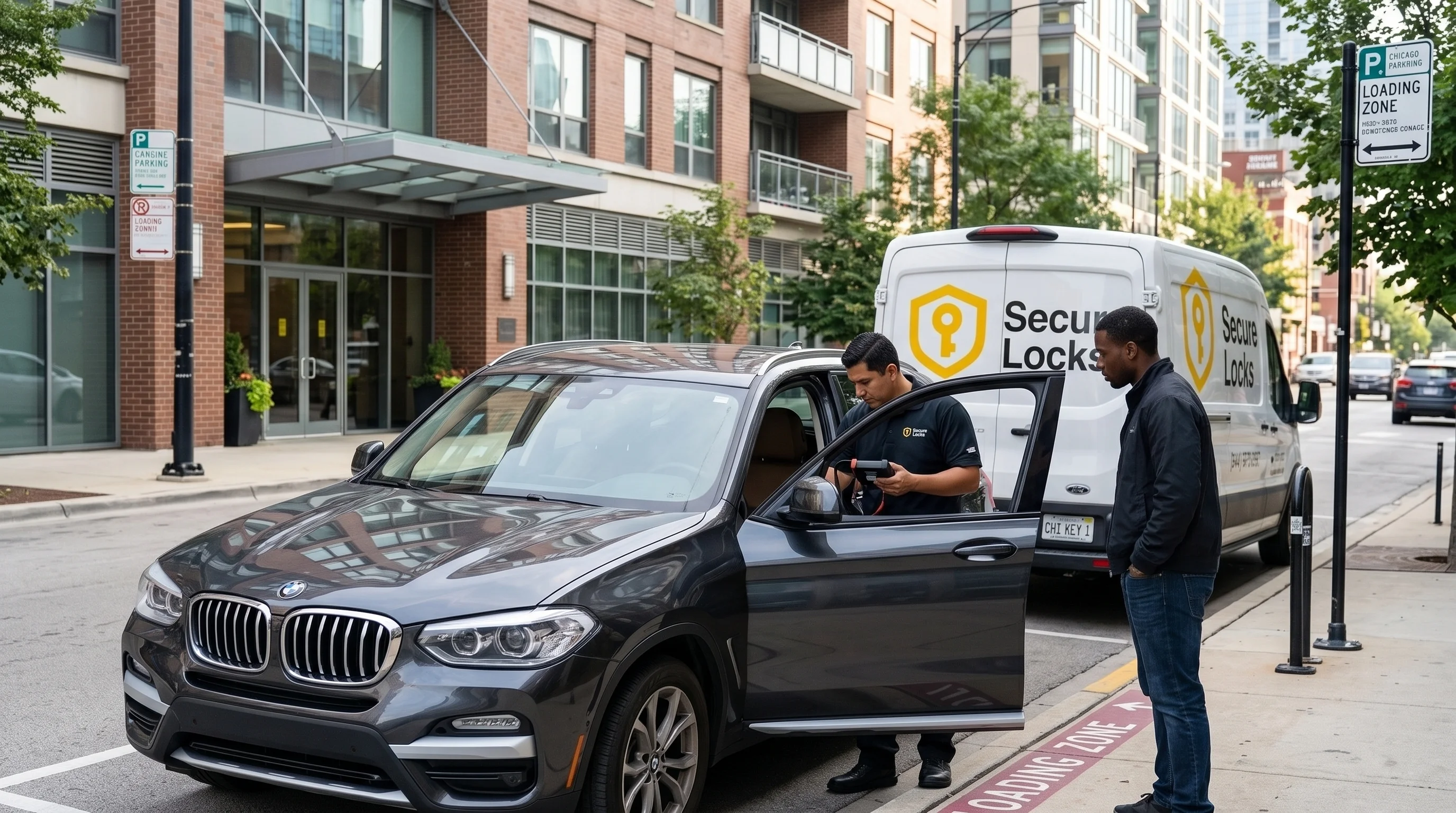
The BMW X3 is a popular choice for Chicago drivers who want a compact SUV that handles winter roads, city parking and highway commutes. Its keys have evolved with each generation, from remote keys used with a start button to Comfort Access fobs that unlock the doors as the driver approaches and, on recent models, display keys with a small screen. When an X3 shows a message that the key is not detected, the instinct is to assume the key is broken and arrange car key replacement right away. In many cases, the cause is simpler and quicker to fix, and a few checks can save an appointment that was never needed.
A key not detected message means the car could not complete its exchange with the key at that moment. That can happen because the key is weak, because something is interfering, because the key is in the wrong place or because a component in the car is not working correctly. Checking each possibility in order sorts out the cause quickly.
How the X3 Detects Its Key
When the start button is pressed or a door handle is touched on an X3 with Comfort Access, the car sends a low frequency signal through antennas placed around the cabin and doors. The key answers with an encrypted response, and the car's security module checks that response against its list of authorized keys. On models without Comfort Access, the key still communicates with the car when the start button is pressed, but the driver uses the remote buttons to lock and unlock.
The security module has changed over the years. Earlier X3 generations used the Car Access System, commonly called CAS, while later models moved key management into body control modules known as FEM and BDC. That difference matters if a new key is eventually needed, but for detection problems the first checks are the same across generations.
Where the Key Sits Inside the Cabin
The interior antennas cover specific zones. A key tucked into a bag on the rear floor, placed inside a metal container or sitting next to a phone may fall outside the area the car checks when the start button is pressed. Simply moving the key to the center console or the cupholder area resolves a surprising number of key not detected messages.
Check the Key Battery First
A weak battery is the most common reason an X3 fails to detect its key. As the battery ages, the key's reply becomes weaker, and Comfort Access is particularly sensitive to that change. The remote buttons may still work from close range long after keyless detection has started to fail, which leads many owners to assume the battery is fine when it is not.
Replacing the battery with the exact type listed in the owner's manual is the first step. It should be installed with the correct side facing up and seated firmly against the contacts. For display keys, which use a rechargeable battery, a full charge is the equivalent step. Chicago winters make battery problems more frequent, since cold reduces output, and many X3 owners first see the message on a frozen morning after the car has been parked outside.
Inspecting Contacts and Housing
A fresh battery only helps if it makes solid contact. The metal tabs inside the key can bend, lose tension or corrode after exposure to moisture. A cracked housing can let water reach the circuit board. Looking for residue around the battery area and checking that the battery does not shift when the key is shaken can reveal problems that a new battery alone will not fix.
Use the Backup Start Position
BMW provides a backup method for starting the X3 when the key's battery is too weak for normal detection. The owner's manual shows the exact location, which on many models is a marked spot on the steering column or a designated area in the console where the car can read the key at very close range. Holding the key in that position and pressing the start button often gets the car running.
If the car starts this way, the key's transponder still works and the car still recognizes the key. The problem lies in the key's battery or radio transmission, not in its programming. If the car does not start even in the backup position, the key or the car's security components need closer attention.
Testing the Spare Key
The spare key provides the clearest comparison. If the spare is detected normally, the main key is almost certainly the problem. If the spare shows the same message, the car is the more likely source. This test takes a minute and prevents replacing a key that was never at fault.
Ruling Out Interference
Radio interference can disrupt detection, especially in dense parts of Chicago. Busy garages, downtown streets and areas with heavy wireless activity can make detection less reliable in certain spots. Inside the car, phone chargers, dash cameras and other plug-in devices can add noise. Moving the car, unplugging accessories and keeping the key away from phones and metal objects are simple ways to rule interference out.
Checking the Car's Own Battery
A weak vehicle battery can affect key detection, since the car's modules need stable voltage. If the engine cranks slowly, the dashboard shows other warnings or the car has been parked for several cold days, the vehicle battery should be tested before the key is blamed. This is one of the most common hidden causes of key problems during Chicago winters.
Signs the Car Is the Source
Several patterns point toward the vehicle rather than the key. Every key shows the same symptom. Some door handles respond to Comfort Access while others do not. The message appears alongside other electrical warnings. The problem began after unrelated electrical work on the car. In these cases, the antennas, door handle sensors, security module or electrical supply deserve a closer look, and replacing the key would not change the outcome.
When Comfort Access Fails at One Door
If one door handle unlocks the car and another does not, the key is working and the problem is in the unresponsive door's antenna or sensor. Road salt, moisture and heavy use can wear these components over time. A technician can test each antenna to confirm which one has failed.
When Car Key Replacement Is the Right Step
Replacement becomes the right answer when the key is lost or stolen, when its circuit board has been damaged by water or impact or when the spare works normally and the main key continues to fail after every other check. A new X3 key must be prepared using data from the car's security module, cut with an emergency blade that matches the locks and programmed to the vehicle. The dealership route typically involves ordering the key, waiting for it to arrive and bringing the X3 into the service department, which means a tow when no working key is left. A locksmith equipped for BMW does the same work where the car is parked, usually in a single visit.
The process depends on the generation. Many CAS and FEM era vehicles can be handled on site by an automotive locksmith equipped for BMW, while some of the newest models may involve additional steps. Proof of ownership, such as a photo ID and the title or current registration, is required before any work begins.
Car Key Replacement Checklist for X3 Owners
Before the appointment, gather the documents, note the model year and the vehicle identification number and bring any existing keys, even ones that no longer work. Once the new key is programmed, every function should be tested: remote lock and unlock, liftgate release, Comfort Access at each door, engine start and the emergency blade in the driver's door. If the old key was lost or stolen, ask whether it can be removed from the car's memory.
What to Expect on Site
When the work is done where the X3 is parked, the technician will need access to the driver's seat and the diagnostic port, along with enough room around the driver's door to cut and test the emergency blade. In a home driveway that is easy. In a crowded Chicago garage or on a narrow street, it helps to confirm in advance that the car can be reached and that the technician can park nearby. A healthy vehicle battery also matters, since programming depends on stable voltage.
Adding a Spare at the Same Time
If the X3 has only one working key, the replacement appointment is a good moment to add a spare as well. Adding a key while one works is usually simpler than recovering from a situation where every key is gone, and having two keys removes much of the stress the next time a problem appears.
A Simple Order of Checks
For BMW X3 drivers in Chicago, a key not detected message is usually solvable without replacing anything. Move the key closer to the center of the cabin. Replace or recharge the key battery. Check the contacts and housing. Try the backup start position. Test the spare key. Rule out interference and check the vehicle battery. If the car appears to be the source, have the antennas and modules inspected. When the evidence points to a damaged or missing key, a properly programmed new key restores every function, and that is the point where car key replacement is the dependable solution.