

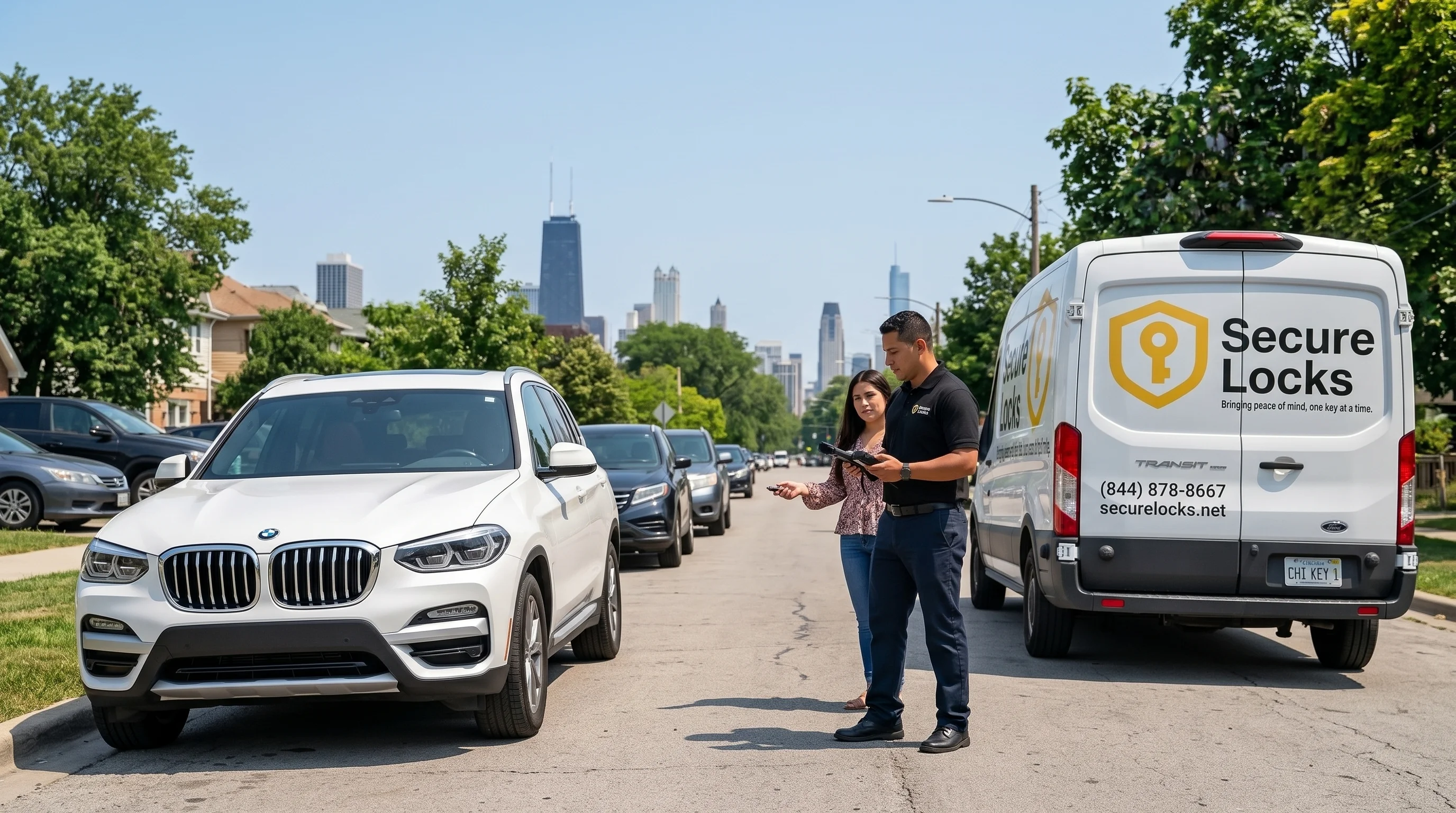
A BMW key fob that used to unlock the car from across a parking lot and now needs to be held a few steps away is sending a message. Shrinking range rarely happens all at once. It creeps in gradually, until the owner realizes that the car only responds when the fob is pointed directly at it from close by. For drivers in Chicago, where cars are often parked in crowded garages, on busy streets or in dark lots during long winter evenings, that change is more than a small annoyance. It is an early warning that something in the key or the car needs attention, and in some cases it is the first sign that car key replacement will soon be necessary.
The good news is that reduced range usually has an identifiable cause, and many of those causes are simple to address. Understanding what range loss can signal helps owners respond before the fob stops working entirely.
How BMW Fobs Send Their Signal
A BMW fob contains a small radio transmitter powered by a battery, or on some display key models, a rechargeable cell. When a button is pressed, the fob sends a coded signal that the car's receiver picks up and verifies. On vehicles with Comfort Access, the car and the fob also communicate automatically as the driver approaches, using antennas placed around the doors and the cabin. The strength of that signal, the sensitivity of the receiver and the amount of interference in the area together determine how far away the fob can be and still work.
Range loss can come from any part of that chain. The fob may be transmitting a weaker signal, the car may be receiving it less effectively, or the environment may be drowning it out. Sorting out which one is responsible is the key to fixing the problem.
Why Range Drops Gradually
Batteries do not usually fail suddenly. As a coin cell ages, its voltage slowly drops, and the transmitter produces a weaker signal. The fob keeps working, but its effective range shrinks little by little. Because the change is so gradual, many owners do not notice it until they find themselves standing right next to the car, pressing the button repeatedly.
The Battery Is the Most Common Cause
In most cases, a weakening battery is behind shrinking range. Replacing it with the exact type listed in the owner's manual often restores the original range immediately. It is worth using a fresh battery from a reliable source, since a battery that has been sitting on a shelf may already be partially discharged. For BMW display keys with rechargeable cells, a key that is not being charged regularly can show similar symptoms, and charging it fully is the first step.
Cold weather speeds up the process. Chicago winters can reduce battery performance significantly, and a battery that was merely tired in the fall may struggle once temperatures drop well below freezing. Owners who notice range loss as winter begins are often seeing the combined effect of an aging battery and cold temperatures.
Contacts and Battery Fit
A fresh battery helps only if it makes solid contact. The metal tabs inside the fob can lose tension or corrode, particularly if the key has been exposed to moisture. A battery that shifts slightly inside the fob may produce inconsistent range, working well one day and poorly the next. Checking that the battery sits firmly and the contacts are clean can resolve these intermittent issues.
Interference Around the Car
Radio interference is a frequent cause of reduced range in cities. Parking garages full of wireless systems, streets lined with electronics and buildings with dense wiring all add signal noise. In parts of Chicago, especially downtown and in busy commercial corridors, owners may notice that the fob works well at home but poorly at work. That pattern points to the environment rather than the key.
Inside the car, aftermarket electronics can also interfere. Dash cameras, phone chargers, radar detectors and other accessories plugged into power outlets can produce noise that affects the fob signal. Unplugging these devices temporarily is a quick test that can reveal whether one of them is contributing to the problem.
Keys Carried Near Phones and Metal
Where the fob is carried also affects range. A fob in the same pocket as a phone, stored in a metal case or buried in a bag may transmit a weaker signal. Some owners use signal blocking pouches to protect against relay theft, which is a sensible precaution, but the key must be removed from the pouch before use or it will not communicate with the car at all.
When the Problem Is in the Car
If a fresh battery and a quiet environment do not restore range, and a spare key shows the same behavior, the problem may be in the vehicle. The car's receiver, the antennas used for Comfort Access or the wiring connecting them can develop faults over time. A weak vehicle battery can also affect how well the car's electronic systems receive and process key signals.
Testing with a spare key is the simplest way to tell the difference. If the spare key works at full range while the main key does not, the main key is at fault. If both keys show the same reduced range, the car deserves a closer look before any time is spent on new keys.
Looking Closer at the Fob Itself
When the spare works and the main key does not, attention shifts to the main fob's physical condition. Keys that ride on heavy key rings, get tossed onto counters or spend years in the pocket of a work jacket take a steady beating. Opening the fob carefully and inspecting the battery area, the board and the button contacts often reveals the reason behind the lost range. What turns up during that inspection decides whether a repair is realistic.
Signs of Internal Fob Damage
A fob that has been dropped repeatedly or exposed to moisture can develop internal damage that reduces its transmitting power. Cracked solder joints, a damaged antenna trace on the circuit board or corrosion spreading across components can all weaken the signal. These problems often cause range to shrink even after a battery change, and the fob may also show inconsistent button response.
Buttons That Need Extra Pressure
Worn buttons can mimic range loss. If a button has to be pressed harder or at a certain angle to work, the fob may be sending weak or incomplete signals. Replacing the housing can sometimes solve this, but when the board underneath is also worn, a new key may be the more reliable fix.
When Shorter Range Points to Car Key Replacement
Replacement becomes the practical choice when the fob continues to lose range after the battery, contacts and environment have been ruled out, and when a spare key performs normally. A new BMW key must be prepared for the vehicle and programmed through the car's security module, whether that is the older CAS system or the newer FEM and BDC modules. The emergency blade inside the fob must also be cut to match the car's locks.
The process requires proof of ownership, such as a photo ID and the title or current registration, along with the vehicle identification number to identify the security system and the correct key type. Once the key is programmed, every function should be tested: remote lock, remote unlock, trunk release, Comfort Access if equipped, engine start and the emergency blade.
Acting Before the Fob Fails Completely
The advantage of paying attention to range loss is timing. A fob with shrinking range still works, which means the car can still be accessed and started normally. Adding a new key while the old one functions is usually simpler than dealing with a situation where the only key has stopped working. For owners with just one key, that timing is especially valuable. A Chicago driver who loses the only working key in a stadium lot, a hospital garage or a residential street during a snow emergency faces a much harder situation than one who replaced a fading fob on a quiet afternoon at home. Scheduling the work while the old key still functions also allows the owner to choose a convenient time and place rather than accepting whatever is available in an emergency.
A Simple Plan Before Car Key Replacement
The most efficient approach is to work through the causes in order. Replace the battery with the correct type, or charge a display key fully. Check the contacts and battery fit. Test the key away from busy garages and with aftermarket electronics unplugged. Compare with the spare key. If the car appears to be the problem, have it inspected. If the key is at fault, consider a replacement before it fails.
A fob with shrinking range is a small symptom with a clear message. In a city like Chicago, where parking situations can leave a driver in an awkward spot if a key suddenly stops working, responding early keeps a minor issue from becoming an urgent car key replacement.