

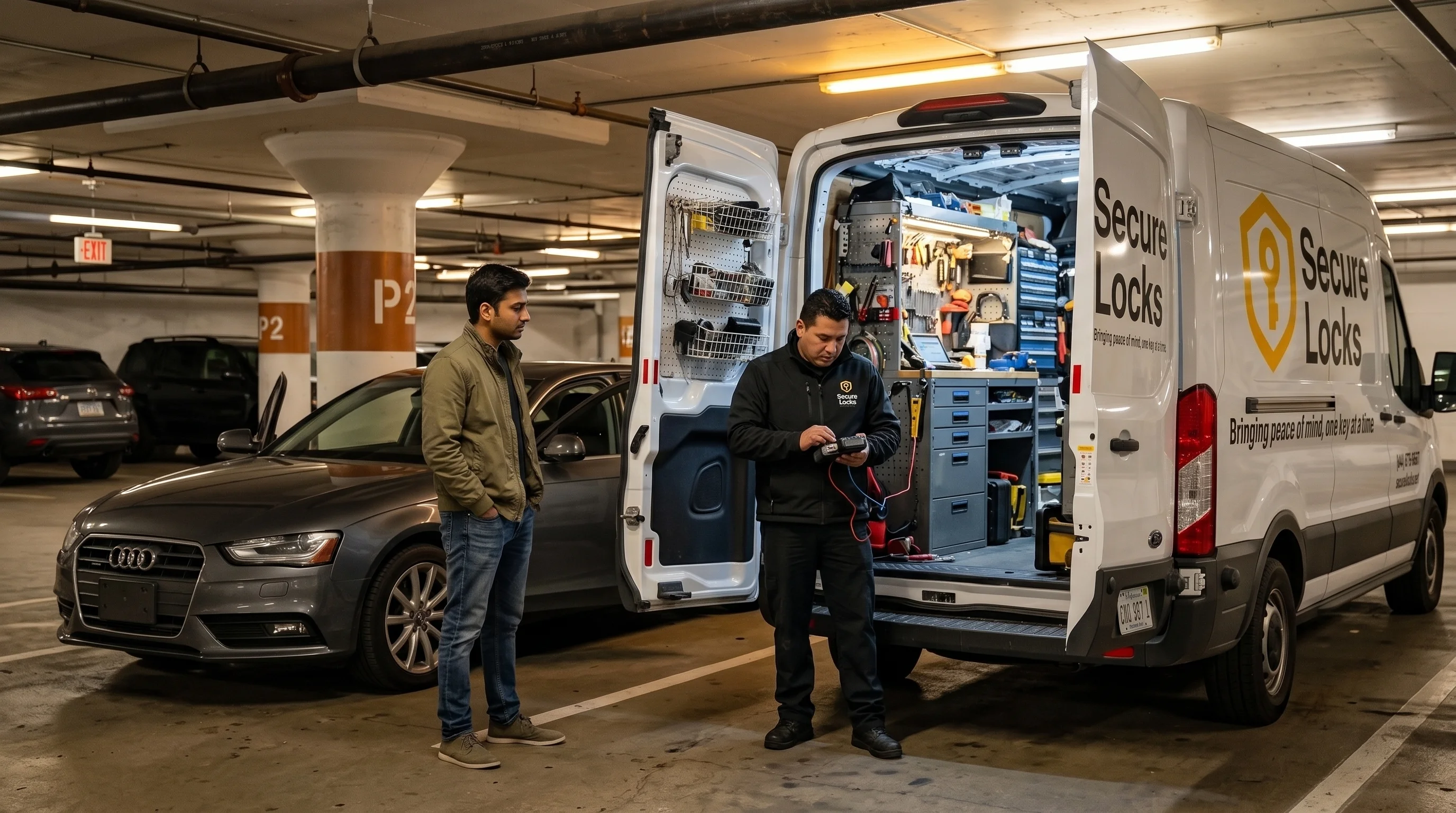
Programming a new Audi key in a suburban driveway is a fairly predictable job. There is room around the car, a strong cell signal, daylight and no gate between the technician and the vehicle. Downtown Chicago is different. Many Audi owners in the Loop, River North, the West Loop and Streeterville park in underground or multilevel garages with access controls, low ceilings, tight turns and limited cell reception. Those conditions do not prevent car key replacement, but they change how the job is planned and, in some cases, how it is carried out. Understanding why helps owners prepare and avoid a wasted visit.
Audi key programming depends on three things: physical access to the car, stable power to the vehicle's electronics and, for some newer models, a working connection to outside systems. A downtown garage can affect all three.
What Audi Key Programming Involves
A new Audi key must do two jobs. Its transponder must be recognized by the immobilizer so the engine will start, and its remote functions must be paired so the buttons lock and unlock the doors. On models with keyless entry and start, the key must also communicate with antennas around the car. Programming introduces the new key to the vehicle's list of authorized keys, and the emergency blade inside the fob is cut to match the car's locks.
The process varies by generation. Older Audi models are widely supported by independent programming equipment and can usually be handled entirely on site. Many mid-generation vehicles can also be programmed on site, sometimes with additional steps to access immobilizer data. Some of the newest models add an online authorization step, and those procedures need a working internet connection during part of the job.
Why the Model Year Matters First
Before anything else, the technician needs the model, year and vehicle identification number. That information determines which immobilizer generation the car uses, which key blank fits and whether the job depends on an outside connection. In a downtown garage, knowing this in advance is even more important, because it affects whether the job can be completed where the car is parked.
Common Reasons Downtown Owners Need a New Key
Downtown drivers lose and damage keys in the same ways as everyone else, but city life adds a few patterns. Keys left at restaurants, hotel bars and event venues in River North or the West Loop are common. Fobs dropped on CTA platforms or left in rideshare vehicles may never be recovered. Keys handed to valet services occasionally go missing or get mixed up. And because many downtown residents drive less often, a fob battery can quietly fade for months before anyone notices. Each of these situations leads to the same practical question: can the new key be made where the car is parked, or does the car need to move first?
Access: Getting the Technician to the Car
The first challenge in a downtown garage is simply reaching the vehicle. Many buildings use key cards, transponders or attendant-controlled gates. A service vehicle may not be allowed past the entrance, or it may need to be registered in advance. Some garages require visitors to park on a different level or in a loading area.
Owners can make this much smoother by contacting building management or the garage operator before the appointment. Asking how a service provider can enter, where they can park and whether equipment can be carried to the car avoids a technician waiting at the gate. If the garage uses an attendant, letting them know that a locksmith is expected helps as well.
Height Limits and Tight Spaces
Downtown garages often have clearance limits that larger service vans cannot pass. In that case, the technician may park outside or on an upper level and carry equipment to the car. Tight parking spaces can also make it hard to open the driver's door fully, which matters because much of the programming work happens from the driver's seat. If possible, moving the car to a wider space, or arranging for it to be moved by the attendant, makes the job easier.
Valet and Attendant Parking
In valet-only garages, the car may be stacked or parked in an area the owner cannot reach. Coordinating with the valet team to bring the car to an accessible spot at a specific time is often the most practical approach. Without a working key, the attendants may need to roll or push the car, which requires care with some models.
Power: Keeping the Electronics Stable
Programming depends on stable voltage. If the car's battery is weak, the immobilizer and control modules may not respond correctly during programming, and the process can be interrupted. Cars that sit for long periods in downtown garages, especially those belonging to owners who rarely drive during the week, may have batteries that are lower than expected.
A technician will usually check the battery before programming and may connect a support unit to keep voltage steady during the procedure. In a garage, that support unit and any other equipment need to be carried to the car, which is one more reason to confirm access and parking in advance.
Cold Weather in Open Garages
Some downtown parking structures are open to the elements on upper levels. In a Chicago winter, a car parked on an exposed level may have a colder, weaker battery than one parked underground. Cold also affects key fob batteries. Scheduling programming for a time when the car can be reached on a more protected level, or in milder weather, can help.
Connection: Why Signal Can Matter
Underground garages are notorious for weak or missing cell signal. For older Audi models that are programmed entirely with local equipment, this does not matter. For some newer models, part of the programming or authorization process can depend on an online connection, and a garage without reception can stall the job.
When a newer Audi needs that kind of connection, the technician may bring equipment that improves reception, work near the garage entrance where signal is stronger or recommend moving the car to a spot with better coverage. In some cases, the most reliable choice is to complete that portion of the work outside the garage. Discussing the model year in advance allows the technician to plan for this rather than discover it on arrival. The alternative many owners assume, having the car towed out of the garage to a dealership service department, means dealing with height limits and ramps, booking an appointment and often waiting days for an ordered key. A locksmith who works inside the garage avoids every one of those steps.
Car Key Replacement When the Car Cannot Move
If the key is lost and the car cannot be driven out of the garage, the plan has to work around the location. For models that can be programmed with local equipment, the job can usually be completed where the car sits. For models that require an online connection, the technician may need to find a workable spot within the garage or coordinate a short tow to an area with better signal. A flatbed tow from a downtown garage requires attention to height limits and ramp angles, so the garage operator should be involved in that decision.
Documents and Building Permission
The technician will verify ownership with a photo ID and the title or current registration before any work begins. In some buildings, management may also want confirmation that the owner has authorized work on the vehicle in the garage. Having both ready keeps the appointment moving.
Testing in the Garage
Once the key is programmed, every function should be tested before the technician leaves: remote lock and unlock, trunk release, keyless entry and start where equipped, engine start and the emergency blade in the driver's door. Testing inside the garage confirms that the key works in the place where the car is usually parked.
When Moving the Car Is the Better Plan
Sometimes the most efficient route is to move the car before the appointment. If a working key still exists, driving the car to a surface lot, a side street with legal parking or a garage level with good signal and space can make programming faster and more predictable. For a downtown Chicago resident adding a spare, this simple step often turns a complicated visit into a short one. If no key is available, the decision depends on the model and the garage, and the technician can advise whether on-site work is realistic or a short tow makes more sense.
Planning Ahead for Downtown Car Key Replacement
Downtown Audi owners can avoid most of these complications with a little preparation. Keep a spare key in a secure location away from the car. Note the model year and vehicle identification number somewhere accessible, such as a photo on the phone. Learn the building's process for admitting service providers before an emergency. If the car sits for long periods, consider having the battery checked periodically.
Adding a Spare Before It Is Needed
Adding a spare key while one still works is almost always simpler than replacing the only key after it is lost, and that advantage grows in a downtown garage. With a working key, the car can be driven to a convenient spot for the appointment, the battery can be checked in advance and any online steps can be completed where signal is strong.
Garage Access Shapes the Job
Audi key programming in downtown Chicago follows the same technical steps as anywhere else, but garage access, battery condition and signal coverage all affect how smoothly it goes. Contacting building management early, confirming the model year and keeping a spare key on hand turn a potentially complicated visit into a routine one. When a key is lost or damaged, planning around the garage ensures that car key replacement can be completed with as little disruption as possible.